Setting Up Your Google Analytics 4 Account Properly
Setting up Google Analytics 4 takes about ten minutes, and Google’s wizard walks you through most of it. Google Analytics 4 itself was designed to be as user-friendly as possible, so the initial setup is nothing crazy. However, the problem is not the setup. The problem is the settings available in the initial setup and how they will later impact your reporting and overall stats.
This guide covers the whole process: how GA4 is structured, how to create a property, how to get the tag onto your site, and which of the automatic tracking settings to keep. Automatic tracking is the new feature for GA4, and it’s most appealing for business owners. It handles a lot of grunt work for you, but understanding the limitations of this automatic tracking system is really important in terms of getting accurate and usable data out at the end.
Before GA4 Setup
You need two things. A Google account, which can be a personal Gmail address or a Google Workspace login, and access to edit your website, or support from someone who has access.
It is worth thinking about whose Google account this sits under before you create anything. Analytics properties are easy to lose access to when someone leaves a business, and while moving access is relatively straightforward, it can be time-consuming. Using a shared or business account rather than an individual’s personal login will save you a headache later. If you need support, you can check out our guide on sharing access to a Google Analytics account.
How GA4 is structured
GA4 has three layers, and you will create all three in a single sitting.
- The account is the top-level container, and it usually maps to a business. One Google login can hold up to 100 accounts, which is far more than anyone needs unless you are an agency.
- The property is the website, and this is where the data actually lives. One account can hold up to 2,000 properties. Most businesses need exactly one.
- The data stream is the connection between the site and the property. A property can hold several, but a single website only needs one.
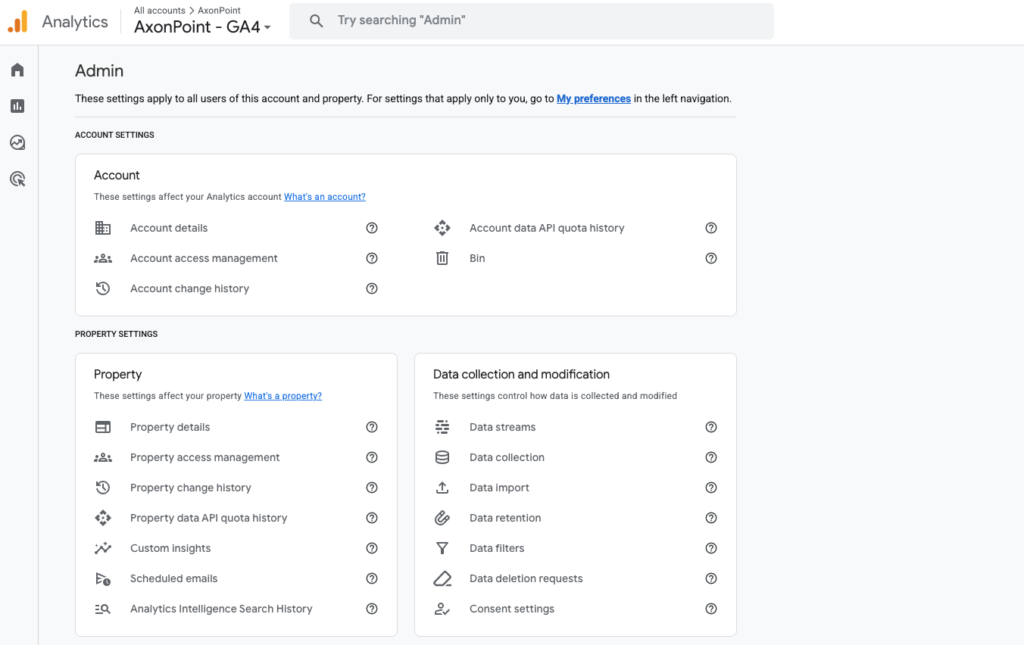
The temptation with multiple properties or multiple streams is to split things up for tidiness: one for the blog, one for the shop, one for a subdomain. Resist it. Splitting data across streams means every report you run afterwards has to be stitched back together manually, and the tidiness is not worth it. Genuine use cases are separate websites entirely or country-specific versions of the same site where you need to report on each independently. For most sites, you’ll get better results with one property and one data stream, and if you are not particularly confident with data, this is a much more manageable solution.
If an agency gives you access to their account, expect to see a long list of properties belonging to other businesses. That is normal, and you will only be able to open the ones you have been granted access to.
Creating your property in GA4
From the Admin section, create the account first, give it your business name, then create a property inside it.
There are a lot of different fields here and most of them have little impact on the account. The two to pay attention to are:
- Reporting time zone. This determines when your days start and end. Get it wrong and your daily figures will be offset against everything else you report on, which is confusing rather than fatal, but it is fiddly to change later. You can generate reports that show events per hour, and matching these up is a lot easier if everything is set to the same timezone.
- Currency. Only relevant if you are tracking e-commerce or assigning values to conversions, but worth setting correctly now rather than discovering the problem later.

Both of these will typically be set to where you are operating from so if you work with international clients, this is definitely worth checking. During this process, you’ll also need to accept a Google agreement. Just make sure that you are agreeing to the correct one for the country that the business is operating in. This is typically only for the first property of an account.
Once the property exists, GA4 will prompt you to create a web data stream. Enter your site address and name the stream. GA4 then generates a measurement ID, which is a code beginning with G followed by a string of characters. That ID is what connects your site to the property.
Getting the tag onto your site
GA4 will offer you installation instructions for most common platforms, and following them is usually the fastest route. The options break down roughly like this:
- A platform integration. Most website builders and CMS platforms have a field where you paste the measurement ID and nothing else is required. This includes Squarespace, Wix, Duda and GoDaddy. If you’d prefer, all of these builders have guides on this and most link you directly to where you need to go in the backend.
- A plugin. The most common option for WordPress and also needed for Shopify. For Shopify, you’ll need to install the Google & Youtube Channel (useful anyway). For WordPress, we recommend Google’s Site Kit plugin. It’s the official option, and it allows for easy verification of Google Search Console as well, which can otherwise be a pain.
- Pasting the code manually. GA4 gives you a snippet to add to the head of every page. This is the most reliable method but it requires a bit more effort and you’ll need edit access of your site. Most website builders limit this option for free plans.
- Google Tag Manager. The most flexible option and the right one if you expect to track anything beyond the basics. It is also a whole separate tool to learn, so it is not where most people should start.
Whichever route you take, the result is the same: the measurement ID ends up on every page of your site. If you already use Google Tag Manager for anything else, use that. Otherwise, take the simplest option your platform offers. Something to be aware of as well. If you are updating a code or replacing one, use the same method as it reduces chance of double tracking or anything getting messed up. You can have multiple streams on a site but it’s not recommended. Also, only install the code once. Adding the code in the backend and then through a plugin is only going to cause double tracking. If your code doesn’t appear to be tracking and you want to try another method, remove the first installation before doing anything else.
Enhanced Measurements
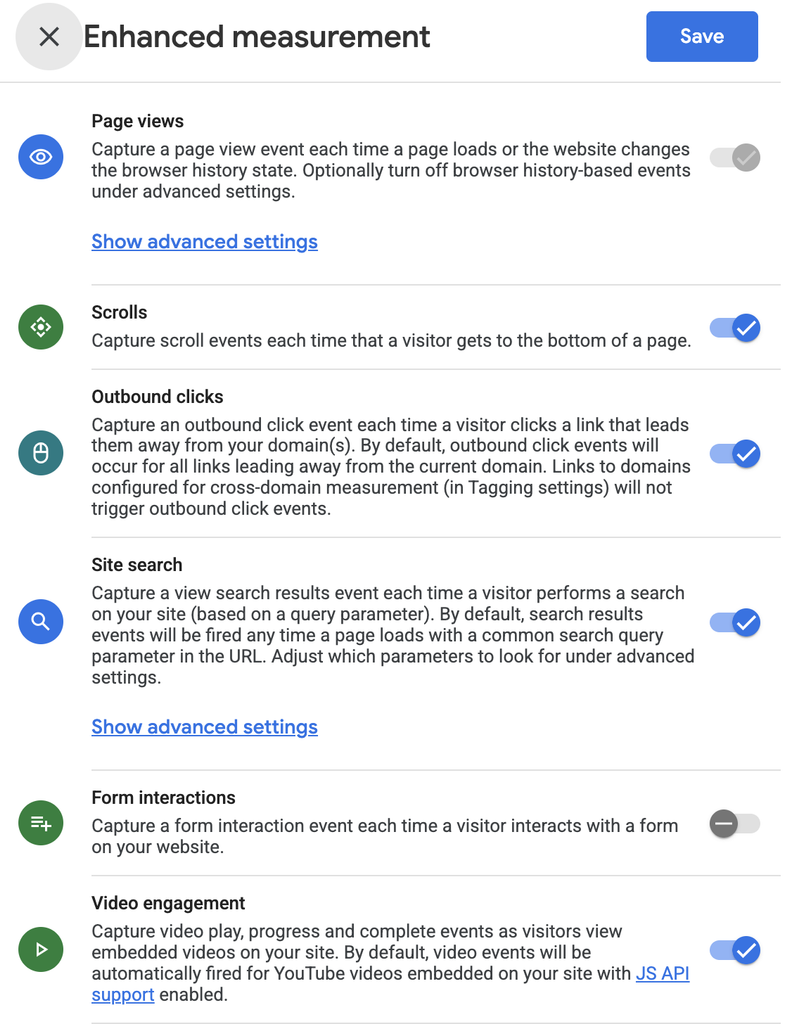
Once your data stream exists, open it and you will find enhanced measurement switched on. This is GA4 automatically tracking a set of common interactions without you configuring anything, and on the whole it is a really useful addition, especially if you aren’t going to be doing much with the account beyond basic setup. There are seven toggles.
- Page views. Records every page load. You cannot switch this off and you wouldn’t really want to.
- Scrolls. Fires once when someone reaches 90% of the page. A worthwhile engagement metric but not particularly useful on its own. If you have a lot of content, you’ll likely see a lot of scroll events.
- Outbound clicks. Tracks clicks on links leaving your site. This is the one people most often misunderstand, because it covers external links only. Clicks on your own phone number or email address are not captured here. It’s mostly useful as an event to use for further tracking as the level of detail at base level is annoyingly vague.
- Site search. Records what people type into your site’s search box. GA4 looks for the common URL parameters by default, so if your search uses something unusual, you may need to add it under the advanced settings.
- Video engagement. Tracks plays and progress on embedded video. Worth knowing that this is YouTube embeds only, so Vimeo, Wistia and self-hosted video will show nothing at all and you’ll need to set this up separately.
- File downloads. Fires when someone downloads a document. Works well and needs no configuration. Again, you might want to set up specific tracking if you are interested in specific file downloads like a brochure or an offline application form.
- Form interactions. Leave this one off. We go into more detail below.
Why you should turn off form interactions
Form interactions is designed to track two things automatically: when someone starts filling in a form and when they submit it. On paper it removes the need to configure lead tracking at all, which for most businesses is the single most valuable thing GA4 could measure.
In practice, it is the least reliable setting in the tool, and as a result, it has little practical value, as you can’t trust the data coming from it.
The core problem is how it detects a submission. It watches for a standard form submit action, which works fine on older forms that reload the page. Most modern forms do not work that way. They submit in the background and show a confirmation message without the page changing, and GA4’s basic detection frequently cannot see those at all. Depending on the form, you get nothing, duplicates, or events firing on interactions that were never submissions.
Worse, it cannot reliably distinguish a submission that succeeded from one that did not. A visitor who hits submit, fails validation because they mistyped their email, and gives up can still register as a form submission. It’s also common for this event to fire twice on each submissions. This has become a bigger issue with GA4 over time and we’ve noticed this across lots of accounts across a wide variety of website builders.
In order to build reliable data that you can actually work with, you need to build out form tracking yourself. To turn the automatic tracking off, open your data stream, click into the enhanced measurement settings, and switch off the form interactions toggle.
How should you track forms in GA4?
Two options, depending on how your forms work.
If your form redirects to a thank you page after submission, you can build the event inside GA4 itself using that page view as the trigger. It is straightforward, it is accurate, and it needs no other tools. We cover it in our guide to understanding events in GA4.
If your form submits without changing the page, which is most of them, you need Google Tag Manager. That is more involved, but it is the only way to get a trustworthy number, and for a business whose enquiries all arrive through a web form it is worth doing properly. Our guide to GA4 vs Google Tag Manager explains where the line falls.
There is also a third possibility worth checking before you build anything: some website platforms push their own form and e-commerce events into GA4 automatically. If yours does, the work may already be done. Look at your events list before you start and you’ll want to look for events like ‘generate_lead’. The best platform we’ve seen for this is Wix which is really well integrated with GA4.
Checking Your GA4 Tag is Working
Open the Realtime report and visit your own site in another tab. Within a minute or two you should see yourself appear. If nothing shows, wait a few minutes before assuming it is broken. We recommend trying with an incognito tab as GA4 can sometimes detect if you’re logged in and not tracked. Please be aware that this can take up to 48 hours to reliably pull in data. We often do our analytics and tracking updates on a Friday. That way, the site has 2 full days to start pulling in data before we review it on Monday morning. For further troubleshooting, check out our guide to troubleshooting your GA4 account.
Setting up a Google Analytics account isn’t particularly complicated, and it’s gotten easier with the introduction of GA4. The whole process takes about 10 minutes from start to finish, so it’s worth taking the time to ensure that everything is set up correctly from the beginning. For more information on Google Analytics 4, you can check out our complete guide to Google Analytics.
What is GA4? A practical guide to Google Analytics 4
It’s no secret that the launch of Google Analytics 4 and the past few years of using it have been met with backlash. Initially designed to be a more immediately approachable data tool for business owners, it’s often been a confusing tool to make use of and while definitely more convenient than Universal Analytics, it can often be a struggle to get anything of use out of it. It is the most widely used traffic tracking tool in the world, and it is also one of the most widely ignored, largely because the interface assumes you already know what you are looking for.
This guide is designed to help break it all down. It covers what GA4 is actually for, how it is put together, which reports matter, and where the numbers deserve a second look. If you tried to understand everything in GA4, you’d be quickly lost in the numbers, so this is made specifically to provide you with the key insights you need.
What GA4 is for
At its simplest, GA4 tracks two things: traffic and leads. Who came to your website and what they did once they got there.
The obvious question is why you need a separate tool for that when your own systems already tell you how many enquiries came in. The answer is attribution. At its core, GA4 gives you visibility of where your traffic and your leads are coming from and where your time is best spent. The accuracy of that data is paramount and one of the bigger struggles when it comes to GA4 in particular.
Setting a GA4 account
Setting up GA4 means creating an account, then a property inside it, then a data stream inside that. In practice this all happens in a single wizard, and you can be through it in a few minutes.
The three layers do mean something, though:
-
- The account is the top-level container. It usually maps to a business, and one Google login can hold up to 100 of them.
-
- The property is the website itself, and this is where your data actually lives. An account can hold up to 2,000 properties, which is far more than most businesses will ever need. If you run multiple websites, multiple properties are worth setting up, but for most businesses, one account and one property will be fine.
-
- The data stream is the connection between your website and the property. You can have several in a property, but for a single website you only need one, and adding more usually creates more problems than it solves.
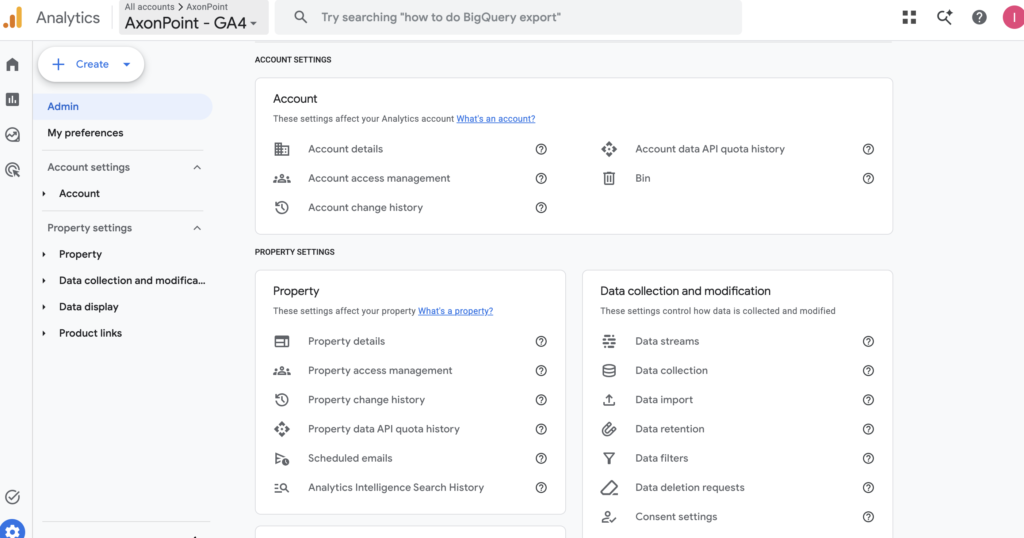
The setup wizard will give you installation instructions for most common platforms (such as Wix and WordPress), and following them is straightforward and easy enough for most sites. There is one setting worth changing before you walk away from it, which we cover in our guide to setting up GA4 properly.

Finding your way around GA4
GA4 has four main sections. Home gives you a snapshot when you log in. Reports holds your actual data. Explore lets you build custom reports once you know what you want. Advertising covers paid performance.

You will spend almost all of your time in Reports. Explore is powerful and worth learning eventually but it is only useful once you have a specific question you need answering. When you are just trying to understand your data, the generated reports will be fine.
There is also a real-time report, which shows a rolling 30-minute window of live activity. It sounds like the most exciting thing in GA4 but it is mostly a testing tool. Unless your site gets significant daily traffic, a half-hour window will show you a handful of visits and not much else. It comes into its own when you have set something up and want to check it is working.

Realtime report is also slow and occasionally unreliable. It can take a minute or two to refresh, and new events may not appear for a day or so. It is worth noting that the main reports also run one to two days behind as well. If something looks missing, it is usually not broken, it is just late.
Reading GA4 reports
The two reports you will use most are the user report and the traffic report. They look similar and they answer slightly different questions.
The user report counts users, meaning unique people. The traffic report counts sessions, meaning visits. One person visiting your site four times in a month is one user and four sessions, which is why the traffic report always looks healthier than the user report. Neither is more correct. They just measure different things, and most of the confusion around analytics reporting comes from two people quoting different metrics at each other without realising it.
The traffic report is the more detailed of the two by default, and it reports e-commerce data without you having to configure anything, so it tends to be the better starting point.
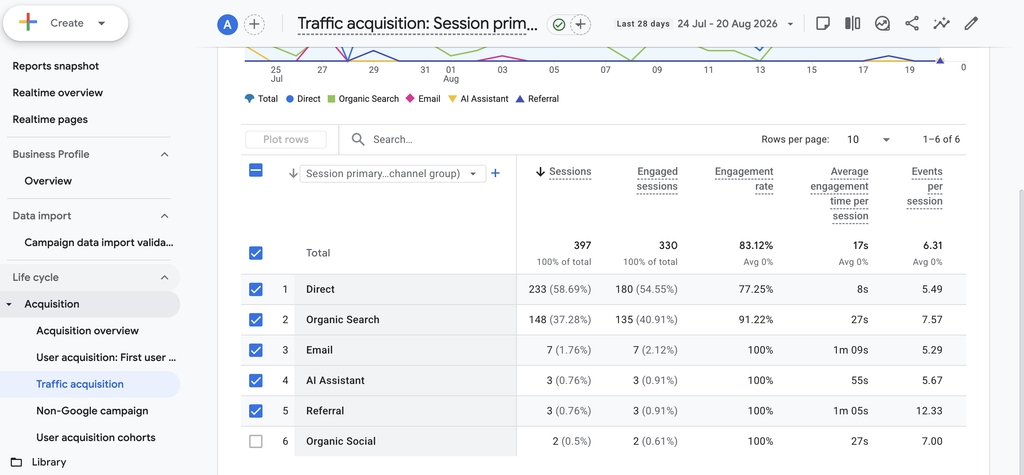
In each report, you can set a data range to your liking. The default is set to 28 days but you can view back as far as you want. You can also toggle a comparison. This is set by default to match day of the week, but you can change this and you can compare against the previous period, the previous year or a custom window if you prefer.

Both reports break performance down by channel:
-
- Organic search – clicks that came from Google, Bing or another search engine
-
- Direct – someone enters your site URL in the top bar
-
- Paid search – Google Ads and Microsoft Ads traffic
-
- Organic social – any social media activity
-
- Paid social – your paid social media efforts
-
- Referral – any clicks coming from external websites i.e. business listings or partner sites
-
- Email – any clicks from your emails. Most email tools will automatically set up this tracking for you
-
- AI assistant – any clicks from the various AI tools; i.e. ChatGPT, Gemini and Claude
-
- Unassigned – not as big a deal as it was at the beginning of GA4 but any traffic that can’t be assigned a channel. Most common when looking at the last 48 hours before traffic can be properly assigned.
Direct is the channel to treat with suspicion. In theory it means someone typed your address straight into their browser. In practice, changes to cookies and consent handling have turned it into a catch-all for anything GA4 cannot confidently attribute, which means a chunk of your direct traffic is really something else wearing a disguise. If you run Google Ads for example, it is not unusual to see a spike in direct traffic. It is still useful, but it is the last number you should build an argument on.

For anything more detailed, switching the report dimension to source and medium will show you what is actually driving each channel: Google and Bing under organic, Facebook and Instagram under social, and so on. You can do this by clicking on the dropdown box in the report like below.

Events and key events in GA4
Everything a visitor does on your site is recorded as an event. To view these, there is a events report in the reports section but we recommend using the Events section in GA4. This allows you to see your tracked events, events you have set up and your key events.

GA4 creates a set of these automatically, and most are self-explanatory: page views, scrolls, outbound clicks, file downloads. The main one we would recommend turning off is form tracking. It’s difficult to know what exactly it is tracking, and most forms simply can’t be tracked purely in GA4. For this, you will need to use Google Tag Manager or build something internally.
A key event is typically an event that acts as the end point for a user journey. Google used to call these goals, then conversions, and now key events, which is worth knowing purely so that older guides make sense. Typically these are form submissions, purchases, appointment bookings, and phone or email clicks. To mark a key event, you need to click the star next to it in the event menu in Settings.

Two things catch people out here.
The first is that GA4 no longer tracks phone and email clicks automatically. If those matter to your business, and they do for most local businesses, someone has to set them up.
The second is the delay. A new event will not appear in your list until a day or two after it first fires, which means setting one up is a two-part job: create it, then come back later to mark it as a key event. Skipping the second half is the single most common reason a business looks at its analytics and sees zero conversions.
It is also worth checking what is already in there. Some website platforms push their own events into GA4, and Google Ads can add its own and mark them as key events without asking. GA4 also now adds qualify_lead and close_convert_lead. You will want to remove these by unclicking the star as they won’t provide any data but they will make your key event report messier.

Connecting Google Business Profile to GA4
Under ‘Settings’, you will find Product Links, which connects your property to other Google tools. Most of these are optional, and Google explains them poorly. However, two are not optional.

Google Ads is the obvious one, and if you are spending money on ads, linking it is straightforward and should be a priority. Simply click it and then follow the instructions. You’ll want the Google Ads and Google Analytics accounts to be managed under the same Google account if possible.
Google Business Profile is the newer link and the more interesting one for local businesses. Once connected, GA4 generates a Business Profile report that mirrors much of your GBP performance data. The main advantage is history. GBP itself gives you a fairly short reporting window of 6 months, and in our own testing the linked GA4 report has held around 18 months of data, which makes year-on-year comparison much easier.

It is not a complete replacement. The report has no visibility data, so profile view counts still have to come from GBP directly, and if you link multiple locations, you get one combined view rather than the ability to look at each separately. Data is also lost daily as Google applies a strict 18-month window.
Still, for a local business, this is the closest thing to a free upgrade in the whole tool, and the sooner it is connected, the more history you will have when you need it.
Where GA4 stops
GA4 can track a reasonable amount on its own, but it has a hard ceiling. It handles page view events, outbound clicks, and form submissions that redirect to a thank-you page. It cannot handle forms that submit without a page change, which is most modern forms, and it cannot handle phone or email clicks or anything conditional.
For those, you need Google Tag Manager, which is a separate tool that sits between your website and GA4. Typically, Google Tag Manager is more dev-focused, but there are plenty of things you can do with minimal knowledge of code or web development.
How much should you trust GA4?
GA4 is not a source of truth. Tracking breaks, consent banners block data, attribution guesses, and a site change can quietly stop an event firing without anyone noticing for a month. Any number that has not been checked against something real should be treated as an indication rather than a fact.
The good news is that the numbers that matter most are usually the ones you can check. Form submissions, purchases and most appointment bookings are numbers that you will be aware of. Either in your site or through your CRM and other platforms. Click-to-calls and click-to-emails are harder to track, but you’ll know if the phone is ringing or not, and email enquiries are easy to check. These numbers are always advisory anyway, but validating them allows you to take away actual lessons from your data.
None of that makes GA4 less worth using but it does mean that you need to invest some time into properly understanding your data and making sure that what it is telling you is truthful. The buck doesn’t stop with GA4 and understanding that will allow you to make better-informed decisions about your business and your marketing.
GA4 tells you which part of your marketing worked. That is true, with one adjustment: it tells you which part of your marketing is working, in the way a weather forecast tells you what tomorrow looks like. Directionally reliable, occasionally wrong, and considerably better than guessing.
Set it up carefully, connect the things worth connecting, check the numbers you plan to act on, and it will earn its place. Log in once a quarter and read the totals without questioning them, and it will mostly tell you what you want to hear. If you want help setting up Google Analytics or better understanding your data, a member of our team will be happy to help, so please get in touch or feel free to read our other guides on Google Analytics.
Can You Run Google Ads Without a Website? A Straight Answer for Trade & Service Businesses

The short answer
For the vast majority of Google Ads campaigns, yes, you need somewhere to send people when they click your ad. Google calls this your “ad destination,” and it’s usually a website or a landing page. Without one, Google has nowhere relevant to send a potential customer, and your Quality Score (which affects both your rankings and your cost per click) will suffer badly. That said, there are a couple of genuine workarounds worth knowing about, especially if you’re a local service business like a boiler repair company.Option 1: Use your Google Business Profile as your landing page
If you don’t have a website, the most realistic route is to set up a Google Business Profile (GBP) first. This is the free listing that shows your business on Google Maps and in local search results, and it opens up a few doors: Local Services Ads, a “pay per lead” ad format built specifically for trades like plumbers, electricians and boiler engineers. These ads sit right at the top of search results, above standard Search Ads, and use your Google Business Profile as the destination instead of a website. No landing page required. Performance Max with a Business Profile as the ad destination. Google will build a simple, Google-hosted page from your Business Profile information (opening hours, service area, reviews, phone number) and use that as where your ad clicks land. A free auto-generated “Business Profile Website”. Google can spin up a very basic one-page site pulled directly from your profile details. It’s not pretty and gives you almost no control over messaging or design, but it’s enough to get a standard Search Ads campaign off the ground while something better is built. The catch: none of this works without the Business Profile itself, and profile verification can take a few days. So if you don’t have a website and don’t have a Business Profile yet, this is genuinely step one, not a nice-to-have.Find Out How to Optimise Your Google Business Profile
Can you run Google Ads with neither a website nor a Business Profile?
Realistically, no, not in any way that would produce useful results for a local trade business. Standard Search Ads, Display Ads and Performance Max all need an ad destination of some kind, whether that’s a proper website, a landing page, or a Business Profile page. Even call-only ads, which just show a phone number, require Google to verify that number against a website first. There is one edge case: if you run a YouTube channel with over 10,000 views, you can monetise it via Google AdSense without a traditional website. For a boiler repair business, this obviously isn’t a practical starting point. The bottom line: a Google Business Profile is the minimum viable foundation for running ads without a website. Skipping it isn’t really an option if you want your ad spend to do anything useful.Why a proper website still wins, even once you’ve got a Business Profile
Getting ads live via a Business Profile is a way to start fast, not a long-term strategy. A dedicated website, even a simple one, makes a real difference to your results: Lower cost per click. A relevant, well-built landing page improves your Quality Score, and Google rewards that with cheaper clicks. More trust. Reviews, photos of past jobs, accreditations and clear pricing all help turn a click into an enquiry. A one-page Google-generated page can’t do this. Better lead capture. A proper contact form or booking widget converts far more visitors than a phone number sitting on a Maps listing. Real conversion tracking. With a website, you can install Google Ads conversion tracking and GA4, so you know exactly which keywords and ads are generating paying jobs, not just clicks. Without a website, that visibility disappears, and you’re optimising blind.
Our recommendation
If you’re weighing this up for your own business, here’s the order we’d suggest:- Set up (or claim) your Google Business Profile straight away. It’s free, it’s the foundation for local visibility generally, and it unlocks Local Services Ads and Performance Max as a stop-gap ad destination.
- Get a simple, purpose-built website live as soon as you can. It doesn’t need to be a huge project. A focused, five-page site covering your services, coverage area, reviews and a clear way to get in touch is enough to run proper Search Ads campaigns and start tracking real leads, not just clicks.
- Run Search Ads to the website, not a Business Profile page, once it’s live. This is where you’ll see the best cost per lead over time.
Google Search Console Updates in 2026
Google Search Console has had a genuinely busy few months. Google has rolled out two updates that, on paper, both promise the same thing: more visibility into where your content is being found and how it performs once it gets there. It’s no secret that the internet is much more interactive than it was even 2 years ago. Social media feeds organic content, which feeds AI which feeds brand visibility and so on and so forth. In practice, one of these new updates delivers real, actionable data. The other is a step in the right direction that, for now, tells you very little you can actually act on.
Here’s a breakdown of both, what they mean for site owners and marketers, and where your priorities should sit.
Platform properties: finally, search data for your social content
On 7 July 2026, Google introduced platform properties, a new property type in Search Console that lets you track how your Instagram, TikTok, X, and YouTube content performs specifically within Google Search and Discover.
This is separate from each platform’s own native analytics. A platform property doesn’t tell you how many views a Reel got inside Instagram; it tells you how many times that Reel showed up in Google Search results, which queries triggered it, and how many clicks it generated from Google specifically. That’s a meaningful gap that’s been missing from most marketers’ toolkits until now.
How it works
Instead of verifying a domain, you authorise Google to connect to an account you control on one of the four supported platforms (Instagram, TikTok, Twitter/X and YouTube). Once connected, you get access to the same reporting structure Search Console already applies to websites:
- Performance report — total clicks, impressions, and the ability to filter by post or query to see what’s actually driving traffic from Google.
- Insights report — a higher-level view of trends, top-performing posts, and how people are discovering your account through Search.
- Achievements — milestone tracking, similar to what’s already in place for website properties.
A few practical points worth knowing before rolling this out for clients:
- No historical backfill. Data only starts collecting from the point you verify the property, so there’s a case for connecting client accounts sooner rather than later, even before there’s a clear use case for the data.
- Gradual rollout. Google has said this is rolling out over several weeks, so availability will vary by account for a while yet.
- It’s additive, not a replacement. This sits alongside your existing website property in Search Console; it doesn’t change how your site ranks or replace standard SEO reporting.
- Good but not vast coverage. Google is always going to prioritise in terms of its service rollouts and while it’s hit the 4 major platforms, Facebook, LinkedIn and Pinterest are some notable omissions. LinkedIn and Threads will probably come down the line but as always, you never know how much support a Google feature will actually get.
Why this matters for agency work
For clients who lean heavily on short-form video or social content, this closes a real measurement gap. Up until now, if a client asked “does our TikTok content actually get found on Google,” the honest answer was “we don’t really know.” Attribution has always been a major point of contention across channels (particularly with increased restrictions on cookies and cross-platform tracking) and there are always going gaps in our knowledge in terms of whether organic is being fed by social or vice versa. Now there’s a direct, first-party way to answer that question and to justify (or challenge) the resourcing behind a social content strategy using the same kind of query-level evidence we’d use for a website. It’s not perfect and we’d expect the rollout to be relatively slow but it’s an encouraging first step.
Search Generative AI performance reports: useful in theory, thin in practice
The second update landed a month earlier, on 3 June 2026: dedicated Search Generative AI performance reports inside Search Console, giving site owners a standalone view of how their pages appear within AI Overviews, AI Mode, and the generative AI features now appearing in Discover.
Google also introduced a related control at the same time: a toggle allowing site owners to opt out of appearing in, or being used to ground, these generative AI features altogether.
What the report actually shows
- Impressions — how often your URLs appeared inside generative AI features across Search and Discover.
- Pages — which specific URLs were surfaced.
- Countries — a geographic breakdown of AI visibility.
- Devices — available for Search results.
- Dates — hourly through to monthly granularity.
This data isn’t new; it was always folded into the overall performance report. What’s new is that it’s now broken out into its own dedicated view, and it’s rolling out gradually (starting with a subset of UK site owners, tied in part to CMA requirements around AI training data controls, before expanding more broadly).
Our take: it’s a visibility report, not a performance report
Let’s be honest about this update. It’s an interesting addition, and it’s clearly the first step in a longer roadmap. But right now, it has limited practical value for marketers, and the reason is simple: there’s no click data, no CTR, and no query-level breakdown.
You can see that your page appeared inside an AI Overview. You can’t see how many people clicked through as a result, what they searched to get there, or whether that visibility translated into any traffic at all. An impression in an AI feature isn’t the same as an impression in a traditional search result because a well-answered AI overview can fully satisfy a searcher’s query without them ever needing to click anywhere. It’s the big contributor to the so-called Zero Click era of Google Search which has greatly impacted the entire search landscape. A page could rack up thousands of AI impressions a month and it tells you almost nothing about whether that’s good or bad for the business. AI is of course important and providing worthwhile metrics to such a wide-ranging sphere is difficult (most tracking and data platforms have given it a go and most of these solutions have major gaps or logical inconsistencies; this is a hard thing to properly quantify, as every result is different). But conversations over AI have often ran into ‘vanity metrics’. Stats that look nice but mean very little. This seems to be yet another example. It’ll look good in a shareholders’ meeting; it’s a nice new chart but you don’t know what the numbers are and you’ve got little chance of making consistent improvements.

Until Google adds query and click (or at minimum, some proxy for traffic impact), this report is closer to a “your content exists somewhere in the AI layer” confirmation than a genuine performance tool. It’s worth checking periodically and worth having as a baseline (particularly given there’s no historical backfill before mid-May 2026), but you shouldn’t be building reporting or strategy decisions around it yet. Google has said additional metrics are coming “over time”, so this is one to keep an eye on rather than one to overinvest in today.
Where I’d focus right now
If you’re managing Search Console across multiple client accounts, here’s the practical order of priorities:
- Connect platform properties for any client running an active social or video content strategy, even ahead of a defined reporting use case, simply because there’s no backfill and every week without a connected property is a week of unrecoverable data.
- Check for Generative AI report access and enable it where available, purely to start building a baseline. The value of this data will increase once click and query data are added, and having a longer history will make future comparisons more meaningful.
- Don’t make opt-out decisions on the AI control lightly. AI is a scary thing right now, and there are many valid reasons to be skeptical or against AI. However, opting content out of AI Overviews and AI Mode removes a growing discovery channel, and it’s one that is going to see very clear investment whether we like it or not. Ethical consumption of AI is something we should all aim for though so it’s important to consider the role of AI in your digital strategy.
Both updates point in the same direction: Google is expanding what Search Console considers “your visibility” beyond the website itself into social platforms on one side and AI-generated answers on the other. In many ways, this is Google slowly catching up to the rest of the marketing world and maybe finally accepting that they aren’t the be-all and end-all anymore. The social tool is an exciting step in the right direction and gives marketers something concrete to work with. The AI side, for now, is a promise of things to come rather than a finished tool, and it’s worth treating it that way until the data catches up with the ambition.
Google News and SEO: An Honest Take on Whether It’s Right for You
Google News is one of those channels that comes up every now and then in conversations about organic growth, usually phrased as a question along the lines of “should we be doing something with that?” It’s a fair thing to ask. Google News reaches a huge audience, the traffic can be highly relevant, and getting featured carries a certain authority that ordinary search listings don’t.
But in our experience the answer is rarely a simple yes or no, and a lot of the advice floating around treats Google News as if every business should be chasing it. Most shouldn’t, or at least not in the way the guides suggest. So here is the straight version: what Google News actually is, how people discover content through it, who it genuinely suits, how to optimise for it if you are a good fit, and (just as importantly) what every other business can take from how it works. No AI slop, just what we’ve learned doing the work.
What Google News Actually Is
Google News launched back in 2002 as a news aggregator. Rather than producing content itself, it pulls links from thousands of publishers and surfaces them to readers based on topic, location and personal interest. The main categories it covers are business, technology, health, entertainment, science and sport, sitting alongside local and world news.
It has moved on a long way since 2002. These days it leans heavily into personalisation, building a feed for each reader based on what they tend to engage with and search for. For publishers, that means a route to an audience that exists outside traditional papers, social platforms and the standard search results page.
The part that trips people up is that “Google News” isn’t really one place. The content that flows through it appears across several Google surfaces. You’ll see it in the dedicated News app and tab, in the Top Stories carousel within ordinary Google Search, in the personalised Google Discover feed on mobile, and even pulled through to YouTube. So when we talk about optimising for Google News, we’re really talking about earning a place across that whole ecosystem.
How People Discover News on Google
Broadly, content reaches readers through Google News in three different ways, and each one rewards slightly different things.
The first is top and trending news. This is breaking, of-the-moment coverage, the stuff that surfaces in the Top Stories carousel or as breaking news in the app. Speed and relevance matter enormously here.
The second is personalised news, which is what fills the “For You” section and the Discover feed. This is driven by a reader’s interests, their topic and publisher preferences, and how usable and engaging your content is once they land on it.
The third is in-depth or detailed content. Longer, more considered pieces tend to do well in the top stories area and in standard search when someone wants more than a headline. This is where authority and genuine analysis carry the most weight.
Understanding which of these you are realistically competing for is half the battle, and it feeds directly into the honest question that comes next.
The Honest Bit: Is Google News Right for Your Business?
Here is where we differ from a lot of the guides. Google News is brilliant for the right kind of website, and largely irrelevant for everyone else. Being straight about that up front saves a lot of wasted effort.
Google News tends to favour:
- News and publisher websites
- Online magazines and large editorial sites
- Large enterprise sites with genuine authority
- Recognised experts and industry leaders in a specific niche
- Any site that publishes frequent, timely, article-style content
If you run a typical small or medium business with strong service pages and a steady blog, Google News probably isn’t your priority, and that’s a perfectly reasonable conclusion to reach. If you sell, say, replacement guttering or run the village dog groomers, the Top Stories carousel is not where your customers are hanging about, and there is absolutely nothing wrong with that. Doing nothing here is not the same as missing out.
That said, there are exceptions worth taking seriously, and there are principles behind Google News that improve your wider SEO whether or not you ever appear in it. We’ll come back to both of those, because that’s where the real value sits for most businesses.

Getting Set Up on Google Publisher Center
If you’ve worked through the above and you genuinely are a good fit, the practical setup is refreshingly simple.
Everything runs through Google Publisher Center, which you access with a Google business account. The first step is to create a publication: you add your publication name (usually your company or title name), your website URL and your location. Google will accept most legitimate businesses that apply, but it clearly favours publishers and online magazines, and it favours sites with real authority on a subject. If your content doesn’t fit that profile, getting listed won’t do much on its own.
Once your publication is set up, you don’t need to upload whole articles. Google News pulls links directly from your site, so the work is really about having a well-structured, regularly updated section for it to crawl, such as a news area or a clearly defined topic hub. Niche, focused content tends to reach its intended audience faster than broad, general pieces, so a tightly themed section usually performs better than a catch-all blog.
What Google News Looks For
Like ordinary search, Google News runs on a set of ranking factors. Many of them will be familiar, but a few carry more weight here than they do in standard organic results.
The core factors are:
- Relevance of the content to the query and the reader’s interests
- Prominence, meaning how widely a story is being covered and discussed
- Authoritativeness, which is arguably the single biggest factor on Google News
- Freshness, because timing matters far more here than in evergreen search
- Location, for local and regional stories
- Language
On top of that, the personalised “For You” feed weighs a reader’s interests, their preferences for particular topics and publishers, and how usable your site is once they arrive.
Authority Is the One That Really Counts
If you take one thing from this section, make it this. Google News strongly favours sites with genuine authority and trust in a specific subject area. Accurate reporting, well-sourced articles and a track record of quality content all feed into that. Before you invest any real effort in Google News, it’s worth being honest about whether your site carries that kind of recognised expertise in its field, because without it the rest of the optimisation is a bit like polishing a car with no engine.
This is the same principle that underpins Google’s wider emphasis on experience, expertise, authoritativeness and trust, and it’s something we factor into content for every client, not just the ones eyeing up Google News. When we wrote a Women in Engineering piece for a conveyor manufacturer in Nottingham, we built it around real, named members of their engineering team and properly cited statistics rather than vague filler. That’s authority signalling in practice, and it helps a page whether it ever reaches Google News or not.
How to Give Your Content the Best Chance
If you’re a genuine fit and you’re ready to put the work in, these are the areas that make the difference.
Start With Trend and Keyword Research
The research stage matters as much here as anywhere. Google Trends is the natural starting point because it lets you filter specifically for news searches. Head into Google Trends Explore, set your location (the UK, for instance), choose your timeframe and topic, then switch the search type to “news search” to surface the terms that are actually gaining traction in news coverage rather than general search. It’s a quick way to see whether there’s genuine momentum behind a topic before you commit to writing about it.
Newsworthiness and Timing
Freshness is doing a lot of the heavy lifting on Google News, so the strongest content usually has a reason to exist right now. Tying a piece to a live event, a seasonal moment or an awareness day gives it a genuine news hook.
This is where the thinking behind Google News pays off even for businesses that will never appear in it. Writing to a live news hook is exactly the discipline Google News rewards, and it makes content sharper, more relevant and more linkable wherever it sits. The same instinct sits behind the digital PR work we do, where the goal is to give a story a reason to be told now rather than at some vague point in the future.
Headlines and Titles
Google News leans heavily on headlines, and its crawlers read them closely to work out whether a piece matches the content and belongs in a feed. There are a few concrete rules worth following:
- Your anchor text should match the article title used on your section pages
- The HTML title tag should match the article’s on-page H1
- Aim for titles between two and 22 words, or roughly 10 to 110 characters
- Keep dates and times out of the title itself
- Don’t lead your anchor text with a number
These are small details, but they’re the kind of thing that quietly decides whether a crawler treats your piece as a clean, newsworthy story or something it can’t quite parse.
Images and Video
Visual content plays a far bigger role in Google News than many people expect. The platform strongly favours articles that carry a relevant image, and a good thumbnail can be the difference between a story being surfaced and being skipped. Video gets the same treatment when it’s well produced and genuinely relevant.
A few practical points:
- Use image structured data so Google knows which image you want as the thumbnail
- Stick to standard file types such as JPEG and PNG
- Make sure images are at a sensible resolution and not blocked from indexing in your robots.txt
- Add video schema for any video content you want surfaced
Getting the visual side right is also just good practice generally. When we handle a product launch, strong, properly tagged imagery is part of what makes a story worth picking up, whether that’s by Google News, a trade publication or a journalist deciding whether to run it.
Article and Video Schema
Structured data is one of the most reliable ways to help Google understand and surface your content. Article schema (and more specifically NewsArticle markup) tells search engines exactly what a page is, who wrote it, when it was published and what it’s about. For any site publishing regular article content, it’s well worth adding, because it makes the content far easier for Google to classify and feature.
Video schema does the same job for video, helping it surface in News and reinforcing its relevance. We treat structured data as a standard part of technical SEO across client sites, because the benefits extend well beyond Google News into rich results and general crawlability.
Technical Foundations
A handful of technical pieces give news content the best possible chance:
- A dedicated news sitemap (separate from your main sitemap) encourages Google to crawl your news section more frequently
- Every page, or at least every topic cluster, should have at least one static text link pointing to it
- Structured data should be present on your article pages
- Republished or syndicated content should be canonicalised or blocked to avoid duplication issues
- URLs should include relevant keywords
- Internal links should connect related articles so Google can understand the relationships between them
That last point about clustering is something we lean on heavily even for non-news clients. We build content clusters around a topic precisely so that related pages support one another and Google can see a coherent body of expertise rather than a scatter of unconnected posts. The same internal-linking logic that helps a publisher in Google News helps any business build topical authority.
How Long Should Articles Be?
There’s no fixed rule, because short and long-form content both perform well on Google News depending on the topic. Breaking and latest news often works best short and fast, while in-depth, analytical pieces tend to do better in the top stories area where readers want more substance.
What matters more than length is whether the content is original, relevant, genuinely insightful and trustworthy, and whether it’s timely. A piece on a fast-moving development needs to be quick and clear.
What Every Business Can Learn From Google News
Here’s the part that applies even if you close this article having decided Google News isn’t for you, which, to be honest, will be most readers.
The things Google News rewards are the things that make all of your content stronger. Genuine authority and expertise on a subject. Freshness and a reason to publish now. Clean, accurate headlines that match the content beneath them. Properly tagged images and structured data. Tight internal linking that builds topical clusters rather than isolated posts. A reason for journalists, readers and search engines alike to take your content seriously.
None of that is exclusive to publishers. It’s the foundation of good modern SEO and good digital PR, and it’s exactly the discipline that gets a small or medium business noticed, whether that’s through Top Stories, local press coverage, a strong organic ranking or a story that a journalist actually wants to run. When we pitch a client’s story to the regional press, the question we’re really answering is the same one Google News asks: is this newsworthy, credible and timely? Get that right and the channel almost takes care of itself.
Our Take
Google News is a genuinely valuable channel, but only for a fairly narrow band of websites: publishers, magazines, high-authority niche experts and businesses that produce frequent, timely, article-style content. If that’s you, the setup is straightforward and the optimisation is well worth the effort.
For everyone else, and that’s the majority, the honest answer is that chasing Google News directly isn’t the best use of your time. The far bigger win is taking the principles behind it, authority, freshness, structured data, clean headlines and topical clustering, and applying them to the SEO and digital PR you’re already doing. That’s where the real, sustainable visibility comes from.

If you’re not sure which camp you’re in, or you’d like a view on whether your content is built to be surfaced and picked up, our team are always happy to take a look. A quick audit usually tells us everything we need to know.
Contact us today.
Deep Dive into Modern SEO
I recently spent a full day at The Bridge Skills Hub in Worksop, attending an East Midlands Chamber event on Modern SEO, led by Ian Lockwood. While the core principles of search are second nature to me through daily work, the landscape shifts rapidly, and sessions like this are an excellent opportunity to pressure-test assumptions, pick up technical nuances, and return to the desk with a sharper edge.
Here is what stood out.
Technical Refinements in Google Search Console
A significant portion of the day was dedicated to Google Search Console (GSC). Even for those who use it regularly, Ian highlighted one frequently overlooked setting: filtering data specifically by the UK. This strips out international spam traffic that can skew performance metrics and provides a cleaner picture of genuine local intent.
One of the most practical takeaways was treating GSC “Impressions” as a proxy for search demand. Because GSC records how often a term is searched, not just how often your site is clicked – it functions as a powerful, free alternative to paid keyword tools. You can use it to identify which terms are worth pursuing before you even rank for them.
Strategic Keyword Research and the “Sense Check”
We explored the Search Demand Curve and the reality of organic click-through rates. CTR drops from roughly 40% for the top position to around 2% by the second page. The message is blunt: if you are not on page one, you are effectively invisible.
A practical keyword research workflow was shared:
- Seed Lists: Begin with obvious terms and categorise them by general, service, and sector, or whatever structure best matches your site.
- Tool Stacking: Use Google Ads Keyword Planner as the primary data source, then supplement with tools like Ryrob and SEOscout to surface long-tail variations.
- The Sense Check: Before committing to a target keyword, look at the actual search results. If a term like “SAP Consultant” returns nothing but job listings, Google has already decided that the search intent is recruitment and you are unlikely to rank there regardless of your SEO strength.
This last point is often underestimated. It is not enough to identify a high-volume term; you must verify that Google is serving the kind of result you can compete with.
Site Architecture and the Logic of Internal Linking
One of the more illuminating sections of the day covered how the structure of your website influences rankings not just for individual pages, but across the site as a whole.
Google assigns each page a score, often referred to as PageRank, based on the number and quality of links pointing to it. The key insight is that internal links – links between your own pages, pass this value around your site just as external backlinks do.
Imagine a simple site with four pages: A, B, C, and D. If page A links out to B, C, and D, it distributes its value across those three pages. Each of those pages gains authority from A, but A itself receives nothing back. The value only flows outward.
Now consider what happens when page D adds a single link back to page A. Suddenly, A receives value from D, which makes A stronger. Because A is now stronger, the value it passes to B, C, and D increases in turn. The entire network rises. Adding a single well-placed internal link can lift the rankings of every page connected to it, not just the page you linked to.
The practical implication is straightforward: audit your internal linking with intention. Your most important pages, key service pages, cornerstone content, should be receiving links from other pages across the site. Orphaned pages (those with no internal links pointing to them) receive no passed value and are, in effect, invisible to Google.
Ian made a point about reducing “dependency hops”, keeping the chain of links between your homepage and any given page as short as possible. The closer a page is to the homepage in link terms, the more authority it naturally inherits.
Content Hubs: Passing Authority to Your Most Important Content
Building on the internal linking logic above, Ian introduced the concept of content hubs, a structural approach to grouping related content and using it to strengthen your core service pages.
The principle works like this. You have a key service page, perhaps about a specific product category or area of expertise. Beneath it, you have a collection of supporting blog posts or articles that go deeper on related subtopics. Rather than leaving those articles scattered across the site with no clear relationship to each other or to the service page, a content hub organises them into a deliberate structure.
The service page sits at the centre, linking out to all the relevant supporting articles. Each of those articles links back to the service page. The result is a tightly interconnected cluster of content, all reinforcing the same topic and all passing link value back to the page you most want to rank.
An important refinement here is relevance filtering. If your service page is about a specific category, the hub at the bottom should only surface articles genuinely related to that category. Showing unrelated content dilutes the topical signal you are trying to send to Google.
Think of it as a spoke-and-hub model. The service page is the hub; the supporting articles are the spokes. Each spoke strengthens the hub, the hub strengthens the spokes, and the whole structure tells Google clearly and repeatedly what this section of your site is about. A well-built content hub also improves the experience for the user, giving them a natural route to explore a topic in greater depth without having to hunt for related content themselves.
Natural Language Processing: Writing for How Google (and AI) Reads
A substantial section of the day covered how Google actually interprets content, a topic that has grown significantly more complex since the introduction of BERT in October 2019.
BERT stands for Bidirectional Encoder Representations for Transformers. Where older models read text word by word in sequence, transformers process each word in relation to every other word in a sentence simultaneously. This makes them particularly good at understanding the intent of the “why” behind a search, rather than just matching keywords.
In practical terms, Google is no longer pattern-matching for keywords. It is parsing sentences, establishing relationships between words, and inferring meaning from structure and context. Ian demonstrated this using Google Cloud Natural Language, a tool that analyses any piece of text and maps out the grammatical relationships between every word: subject, verb, object, modifier, and so on.
The implication for content writers is significant. Google analyses text at the sentence, paragraph, section, and page level. The cleaner and more logically structured your writing, the more accurately it can be understood and categorised.
Writing for the AI Era: Noun Consistency
As AI-generated answers become more prevalent in search results, the way we structure sentences must adapt further. Humans use context and inference to navigate vague language. AI systems are more literal, and they can be tripped up by ambiguous pronoun references.
Ian offered a memorable example:
“Vitamin B12 levels are important. On a TV programme last week, Ian said it should be watched carefully.”
To a human reader, “it” clearly refers to B12 levels. But grammatically, “it” is closer to “TV programme”, and an AI reading the sentence may conclude that the television programme needs to be watched carefully, rather than the nutrient levels.
The fix is simple: always repeat the noun rather than replacing it with a pronoun. Write “B12 levels should be monitored” rather than “it should be watched.” This “Noun Consistency” rule may feel slightly unnatural at first, but it pays dividends for both AI comprehension and accessibility.
Practical NLP Application
Two other practical takeaways for structuring content:
- Connect questions to answers directly. Aim for a one or two-sentence answer immediately after the question, the kind of concise response you would expect from a voice assistant. Structure it as “[Entity] is [Answer],” keeping the question’s language in the answer itself.
- Use precise units and classifications. Specificity matters. “Cook to an internal temperature of 165 degrees Fahrenheit” is clearer to both users and search engines than “cook to 165 degrees.” The more specific you are, the less ambiguity there is for Google to resolve.
Using AI as a Content Tool With Caution
The session acknowledged the growing role of AI in content production, with a measured and sensible take. AI tools are genuinely useful for generating initial ideas, creating raw structural drafts, and flagging gaps in your topic coverage. They are efficient at handling repetitive tasks and can help you move from a blank page to a working draft more quickly.
However, the risks are real. AI-generated content must be reviewed for accuracy, AI models can and do state incorrect information with complete confidence. Grammar, tone, and factual claims all need human oversight before anything is published. Publishing unreviewed AI content is a significant risk, both to your credibility and potentially to your search performance as Google continues to refine its ability to identify and discount thin or low-quality content.
The recommended approach: treat AI as a first-draft tool and a brainstorming aid, not a finished output.
Link Acquisition: Earning Authority from Other Site
Beyond the links you control within your own site, links from external websites remain one of the most powerful signals in Google’s ranking algorithm. This section of the day covered how to build them legitimately and what to avoid.
Understanding Who Links to You
Google Search Console’s Links report shows you which external sites are linking to yours, how many linking pages each domain has, and which of your pages they point to. This is a free starting point for understanding your current authority profile. For a more detailed view; including competitor backlink analysis, tools like Ahrefs allow you to see who is linking to competing sites, which can reveal outreach opportunities and link gaps.
Reciprocal Links
Exchanging links with other websites is a natural part of the web, and Google does not penalise it outright. The key is relevance and proportion. Linking to a supplier, a trade body, or a complementary business makes logical sense and carries no risk. Building dozens of reciprocal links with unrelated sites purely for SEO purposes is a different matter and should be avoided.
Linkable Assets: Do You Have Something Worth Linking To?
Before pursuing external links, it is worth asking whether your site currently has content that someone would naturally want to reference. Linkable assets are resources with genuine standalone value things like free tools, comprehensive guides, original research, industry data, calculators, or templates. A fire safety logbook available for free download, for example, is the kind of resource that other sites might cite or link to naturally because it is useful, not because you asked them to.
If your site lacks this kind of content, link acquisition becomes an uphill battle. Creating something genuinely valuable first gives you a reason to reach out to potential linking sites.
Content That Earns Links
Beyond formal linkable assets, certain content types consistently attract links:
- Case studies showing real-world results or transformations. These are credible, specific, and often referenced by journalists, educators, and bloggers.
- Expert round-ups and interviews featuring multiple voices on a topic. These naturally earn links from the experts involved, and from others who cite the piece as a resource.
- Visual content, infographics, diagrams, original photography which is far more likely to be embedded or shared than a block of text.
The principle across all of these is the same: the content must have value for someone outside your business. It must be informative, useful, or genuinely entertaining. Promotional content does not earn links.
Outreach: Doing It Properly
Once you have something worth linking to, outreach is the process of letting the right people know it exists. A few rules apply:
- Find the right person. Emailing a generic info@ or sales@ address is rarely effective. Take the time to identify the editor, the blogger, or the specific journalist covering your topic area.
- Build some context before you pitch. Look at their recent work, reference something specific, and demonstrate that you have actually engaged with what they do.
- Keep your initial message short. One or two sentences explaining the value of what you are sharing is more effective than a lengthy pitch.
- Follow up once if you receive no response. Many outreach emails are missed rather than ignored.
A useful tactic flagged in the session was monitoring the hashtag #journorequest on X (formerly Twitter), where journalists actively request sources and expert comment. Responding quickly to relevant requests can earn high-quality editorial links with relatively little effort.
What to Avoid
Google is explicit about the link practices it considers manipulative, and the penalties for getting caught are significant. Practices to avoid include:
- Buying or selling links (if a link is paid for, it must use rel=”sponsored” or rel=”nofollow” to avoid penalty)
- Excessive reciprocal link exchanges
- Links hidden in widgets, footers, or site templates distributed at scale
- Links required as part of a contract or terms of service
- Guest posts, press releases, or article syndication used primarily as link vehicles rather than for genuine editorial value
- Low-quality directory submissions
- Forum comment spam or links inserted in signatures
The test Google applies – and the test you should apply- is whether a link would exist if there were no SEO considerations at all. If the answer is no, proceed with caution.
Sophisticated Lead Capture
One section of the day focused on email capture and the user experience of lead generation. The consensus was clear: intrusive pop-ups that fire immediately on page load frustrate visitors and can irritate search crawlers.
A more effective approach targets users who have already demonstrated genuine interest. Two high-intent triggers worth implementing:
- High-engagement users: Those who have spent two to three minutes on a key page or have navigated through to specific service areas. At this point, a prompt to stay connected is far less likely to feel like an interruption.
- Exit-intent users: Those showing behavioural signals of leaving — scrolling rapidly back to the top of the page, or moving the cursor toward the browser’s back button.
These triggers reduce volume but dramatically improve the quality of the sign-ups you capture. Someone who has read your content for several minutes before being prompted is a very different prospect from someone who bounced a pop-up within three seconds of arriving.
Local SEO: Precision Matters
A point raised during the session that is easy to underestimate: geographic precision in local SEO can make or break your relevance signals. If you are targeting a specific location, be explicit. “Beeston, Nottinghamshire” and “Beeston, Leeds” are entirely different places, and if you omit the county, Google may index you for the wrong one.
This level of specificity applies across your content, your Google Business Profile, and your structured data. The more precisely you define your geographic relevance, the more accurately Google can serve you to the right audience.
The Basics Still Matter
All of these advanced tactics rest on a foundation that must be solid. The session closed with a reminder that is worth repeating: none of this works if the fundamentals are broken.
- Contact details must be in plain text, not embedded in an image, so Google can read and verify them.
- The site must be served over HTTPS. An insecure site sends an immediate negative signal.
- Trust indicators must be visible: professional accreditations, third-party reviews from platforms like Trustpilot or Google Business Profile, and clear business information.
These are the baseline markers of legitimacy that both Google and the visitor require before they are willing to take you seriously. Get these right first, then layer everything else on top.

By Dalton Smith from Axon Point. Notes from the East Midlands Chamber Modern SEO session, presented by Ian Lockwood at The Bridge Skills Hub, Worksop.
Local SEO Nottingham: How Independent Businesses Get Found by the Right People in Their Area
There’s a particular kind of frustration that comes with running an independent business in Nottingham.
You know your product is exceptional. You know your service makes a genuine difference. Your existing customers are loyal, your reviews are glowing, and word-of-mouth trickles in just enough to keep the wheels turning. But when you sit down and search for what you actually offer; “yoga studio Nottingham,” “sustainable café Hockley,” “marketing consultant Lace Market,” your business is nowhere to be seen.
Instead, you see national chains with no local presence. Or that one competitor who, frankly isn’t half as good as you, sitting comfortably at the top of the page, picking up every customer that should have been yours.
If you’ve looked into local SEO for Nottingham before, you’ve probably been met with a wall of jargon, an overpriced agency proposal, and a monthly PDF report you’ve never fully understood. You were promised results, you paid the invoice, and your phone stayed quiet.
This article is for you. No jargon. No smoke and mirrors. Just a plain-talking, practical guide to how independent Nottingham businesses can get found by the right people in their area and what’s actually standing between you and a busier diary.
What Is Local SEO, and Why Does It Matter for Nottingham Businesses?
Local SEO or local search engine optimisation is the process of making sure your business appears in Google’s results when someone nearby searches for what you offer.
It’s not about ranking number one in the world. If you run a florist in Arnold, you do not care whether someone in Aberdeen finds your website. What you care about is whether someone three streets away, searching for “florists near me” finds you before they find anyone else.
That’s exactly what local SEO does. It connects your business to the people in your city, your neighbourhood, and your community, whether they are looking to buy right then and there or they are just looking for options. Local SEO means you are always front and center in the minds of the people who matter most.

Why Nottingham Specifically?
Nottingham is a city of independents. From the boutique coffee shops of Hockley to the family-run restaurants dotted across Sherwood and West Bridgford; the heartbeat of this city is small business.
But because Nottingham is a thriving hub, the digital space is crowded. National competitors with sizeable marketing budgets are targeting your search terms. Other local businesses, some with agencies behind them, are actively working to appear above you.
If you’re not actively managing your Nottingham local SEO, you’re not simply staying still. You’re falling behind. Every week that passes without attention to your local search presence is a week of potential customers finding someone else.
The good news? The playing field is more level than you might think. Google wants businesses like yours and more than willing to push them to the top, given that they can find you. With the right foundation, an independent business with local roots and a trusted reputation can outrank a national chain. Google wants to show people the most relevant local result. Your job is to make it obvious that’s you.
Local SEO Nottingham Step One: Claim Your Territory — The Google Business Profile
If local SEO for independent Nottingham businesses had a single foundation, it would be your Google Business Profile (GBP). This is the listing that appears in the “Map Pack”, the cluster of three local businesses that shows up at the top of a search result, complete with a map, phone number, opening hours, and reviews.
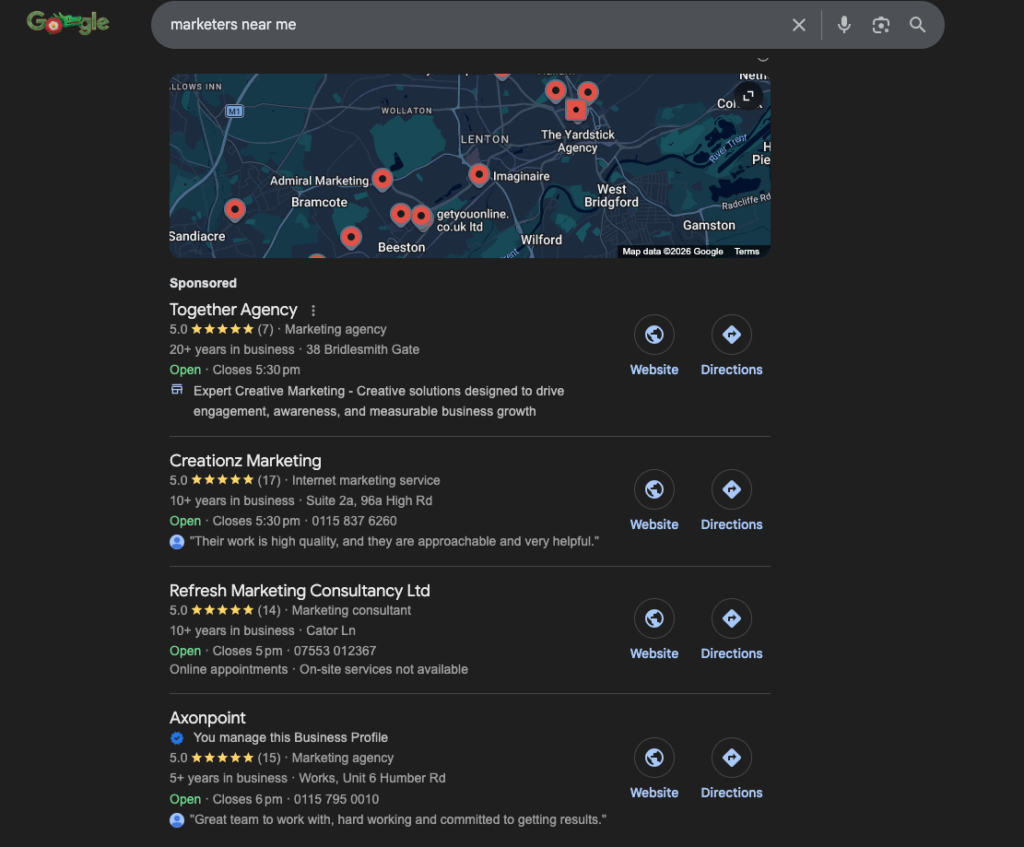
For the vast majority of independent business owners, this is the most powerful and most neglected tool available. It’s free, it’s prominent, and when it’s set up correctly, it does an enormous amount of heavy lifting.
How to Get Your Google Business Profile Right
Claim and verify your listing. If you haven’t done this yet, it’s your first priority. Go to Google Business Profile, add your details and follow the verification process. For more information on how to do this, follow our guide on how to verify your Google Business Profile. Until you own your listing, you have no control over what Google shows the world about your business.
Choose your categories with precision. Don’t settle for vague options like “Professional Services” or “Retail.” Be as specific as Google allows. If you’re a specialist accountant for creative freelancers, say so. If you’re a plant-based café, select that. Specific categories help Google put you in front of the right people. If you fit under multiple categories, select as many as possible but make sure the main category is set to your bread and butter.
Get your NAP exactly right and keep it consistent. NAP stands for Name, Address, and Phone number. These three pieces of information must be identical everywhere they appear online: your website, your Google listing, any directory you’re listed in. Even small inconsistencies such as “St.” versus “Street,” a missing flat number, a different area code can cause Google to lose confidence in your listing and rank you lower as a result.
Use real, local photographs. People in Nottingham want to see your shopfront, your team, your workspace, your product. They want to know what to expect before they visit. Stock photography achieves the opposite, it creates distance at exactly the moment you want to build trust. Take photos of your actual space and upload them regularly. Every 3 months or so, Google begins to treat your account as inactive and this can have a big impact on performance so regular photos are a must.
Post updates consistently. Google Business Profile lets you post updates, offers, and announcements in much the same way as social media. These posts signal to Google that your business is active, which is a quiet but meaningful ranking factor.

Local SEO Nottingham Step Two: Speak the Language Your Customers Are Actually Using
A lot of businesses target the wrong keywords. Either they’re too broad, competing with national giants on terms that are impossible to win or they’re too vague, attracting people who aren’t interested in buying.
When we talk about local SEO services Nottingham, the focus is always on search intent. There’s a world of difference between someone searching “what is social media marketing” and someone searching “social media manager Nottingham.” The first person is curious. The second person is shopping. Your goal is for your main pages to reach the latter person, every single time. Broader keywords still have value but save those for your blogs.
The Keyword Strategy That Actually Works for Independents
Service + location combinations are your bread and butter. These are the searches that signal clear, local buying intent: “accountant West Bridgford,” “personal trainer Beeston,” “graphic designer Nottingham city centre.” Build your website content and your Google Business Profile around these phrases naturally, not stuffed artificially into your text, but woven in as you’d speak to a customer.
“Near me” searches are already captured by good local SEO. Google knows where your customer is when they search. When someone types “coffee shop near me,” Google delivers local results. You don’t need to literally use the phrase “near me” in your content but by strengthening your local SEO in Nottingham overall, you’ll naturally appear in those results.
Hyper-local landmarks and neighbourhood names add context. Referencing the Old Market Square, the Trent Bridge area, the Creative Quarter, the Victoria Centre, or the University of Nottingham helps Google anchor your business firmly within the city. It also helps customers who are thinking geographically, “I need someone close to the city centre” or “I’d rather use someone in Beeston.”
Don’t neglect specific service pages. If you offer three or four distinct services, each deserves its own page optimised for its own local keyword. A single homepage trying to cover everything dilutes your relevance for any individual search.
Local SEO Nottingham Step Three: Make Your Website Work for You
Your website is your digital shopfront. If the lights are off and the shelves are empty, visitors will leave and so will Google’s crawlers.
Improving your local SEO through your website isn’t about doing anything technically dazzling. It’s about making it easy for both Google and your potential customers to understand exactly who you are, where you are, what you offer, and why you’re the right choice.
On-Page Essentials for Nottingham Independents
Your page titles and headings should reflect your location and service. The title of your homepage, the text that appears in the browser tab and in search results should include your primary keyword naturally. “Axon Point | Local SEO Nottingham” tells Google and the searcher exactly what to expect. Don’t leave it as “Home” or your business name alone.
Create location-specific landing pages if you serve multiple areas. If you work across Arnold, Carlton, Long Eaton, and the city centre, a single generic “we serve all of Nottingham” page is a missed opportunity. Dedicated pages for specific areas allow you to rank for those more specific searches and demonstrate genuine local knowledge.
Embed a Google Map on your contact page. It seems simple, but this confirms your physical location to Google’s crawlers in a way that text alone doesn’t. It also makes life easier for customers who want to visit you.
Mobile performance is non-negotiable. The majority of local searches happen on smartphones often while someone is out and about, looking for somewhere to eat, a service provider to call, or a shop to visit. If your website takes longer than three seconds to load, or if it’s awkward to navigate on a phone, you’re losing customers before they’ve read a single word. Test your site on mobile regularly.
Write genuinely useful, local content. A blog or resource section with articles relevant to Nottingham, your area, your industry, your community signals to Google that you’re an active, knowledgeable presence in your field. You don’t need to publish daily. A thoughtful, well-written piece every month or two is worth far more than a stream of thin, generic posts.

A Word on the “Too Busy” Trap
Here’s something we hear almost every time we speak to an independent business owner: “I know I need to sort out my local SEO, but I’m just too busy running the business.”
That’s completely understandable. It’s how it should be. You should be focused on your clients, your craft, and your team not spending Sunday evenings trying to decipher schema markup or wondering why your meta descriptions aren’t showing up correctly.
But here’s the difficult truth: being too busy to be found is a cycle that gets harder to break the longer it continues. If potential customers can’t find you, your pipeline becomes dependent on expensive paid advertising or the unpredictable flow of word-of-mouth. Neither is a stable foundation for growth.
You don’t need to become a digital marketing expert. You need a clear picture of where you stand and a practical plan for what to fix first.
Axon Point offers a free Local SEO Audit and a 30-minute consultation specifically for independent Nottingham businesses. We’ll look at your current online presence, your competitors, and your local rankings, and give you a no-nonsense breakdown of exactly what’s holding you back and what would make the biggest difference, fastest.
No contract. No jargon. Just clarity.
Claim Your Free Audit & 30-Minute Consultation Here
Local SEO Nottingham Step Four: Reputation Is a Ranking Factor
Independent businesses live and die by their reputation. In the digital world, that reputation is made visible through reviews and Google pays close attention to them.
The quantity of your reviews matters. The recency of your reviews matters. And perhaps most importantly the way you respond to your reviews matters.
Making Reviews Work Harder for Your Local SEO
Ask for reviews, consistently. Most happy customers won’t leave a review unless prompted. Make it a habit: send a follow-up message after a positive interaction, add a QR code in the front window, put a review link to your email signature, mention it at the end of a great client meeting. The businesses that dominate their local search results are usually the ones who’ve made review-gathering a quiet, consistent part of how they operate.
Respond to every review — including the difficult ones. A business that ignores its reviews, or that responds defensively to negative feedback, signals to potential customers that it doesn’t take accountability seriously. A calm, professional response to a critical review often does more for your reputation than the review itself. It shows that you’re human, that you care, and that you can be trusted to handle problems with grace.
Encourage natural, descriptive reviews. When a customer leaves a review that mentions your specific service and location “the best independent marketing consultant I’ve found in Nottingham” it provides a genuine signal to Google about what you do and where you do it. You can’t ask customers to use specific words, but you can prompt them to describe their experience in detail by asking something like: “What was it you needed help with, and what made the difference for you?”
Recency counts. A batch of 40 glowing reviews from three years ago is less valuable than a steady trickle of fresh ones. Aim for consistency over volume.

Step Five: Building Local Credibility Through Links
In the world of search, a link from another website to yours acts as a vote of confidence. When a reputable local website links to you, it tells Google that you are a legitimate, trusted part of the local ecosystem.
Most agencies chase links from random websites with no geographic relevance. That approach has minimal value for a local business. What matters for local SEO campaigns in Nottingham is being genuinely embedded in the Nottingham community, online and offline and making sure that’s reflected across the web.
Where Nottingham Independents Should Be Building Links
Local business directories and chambers of commerce. Are you listed with the Nottinghamshire Chamber of Commerce? Are you in the Federation of Small Businesses directory? These are trusted, locally relevant links that carry genuine weight.
Local press and media. The Nottingham Post, LeftLion, and local industry blogs are far more valuable to your local search engine optimisation than a guest post on a generic national blog. If you’ve done something newsworthy, launched something new, collaborated with another local business, supported a community cause, reach out and tell the story.
Community sponsorships and partnerships. Sponsoring a local sports team, supporting a community event, or partnering with a complementary local business can lead to natural links from their websites, as well as genuine goodwill in the community. It’s local SEO with a human face.
Suppliers and professional associations. If your suppliers have a directory of stockists or recommended providers, make sure you’re listed. The same applies to any professional bodies or associations you belong to.
The underlying principle is the same throughout: be a real, active part of Nottingham’s business community, and make sure the digital world knows it.
Why Independent Businesses Get Burned — And How Axon Point Is Different
We’ve heard the story more times than we can count.
You signed a 12-month contract with a national agency. They sent you a generic questionnaire, wrote a few blog posts you’ve never seen any return from, and delivered a monthly report full of metrics you didn’t understand. Six months later, your rankings hadn’t moved. When you raised it, you were told that “SEO takes time.”
It does take time. But it shouldn’t be a mystery. It shouldn’t feel like you’re handing over your budget to a black box and hoping something comes out the other end.
At Axon Point, we only work with businesses we genuinely want to see succeed. Purpose-driven, independent, doing something real, that’s our kind of client. When we run local SEO campaigns in Nottingham, we measure success the way you do: more calls, more enquiries, more customers, more revenue.
We don’t do vanity metrics. We don’t promise what we can’t deliver. And we don’t lock clients into long contracts on the basis of vague promises.
We start with a clear audit of where you are, a plain-English explanation of what’s holding you back, and a realistic roadmap for what to do about it. If we’re a good fit, we’ll tell you. If there’s something simple you can fix yourself, we’ll tell you that too.

Stop Being Nottingham’s Best-Kept Secret
There is no good reason why a national corporation with no local knowledge, no local staff, and no genuine stake in your community should be outranking you for searches in your own city.
They don’t have a better product. They don’t have better service. In most cases, they don’t even have a physical presence in Nottingham. What they have is a better local SEO Nottingham strategy and that is entirely fixable.
This isn’t about gaming the system. It’s about making it obvious to Google, and to the people of Nottingham, that you are the most relevant, most trustworthy, most genuinely local option. When you get that right, you stop being a best-kept secret and start being the local leader.
Take the First Step
If you’re tired of being invisible online while offering something genuinely brilliant, let’s find out exactly why it’s happening.
Axon Point offers a free, comprehensive Local SEO Audit and a 30-minute strategy consultation for independent Nottingham businesses. We’ll assess your current online presence, look at what your competitors are doing, and give you a clear, jargon-free action plan.
No commitment. No confusing reports. Just a straight conversation about what’s possible.
Contact Axon Point today and let’s put your business on the map. Literally.
Updates Coming To Google Business Profile in 2025
We’ve often referred to Google Business Profile as the forgotten child of Google’s various services. A vital and incredibly powerful resource for small and local businesses; it’s often felt like the tool has been abandoned with sporadic updates that only serve to make an already frustrating tool that little bit more difficult to use.
Whether that’s the changes to verifying your Google Business Profile, the constantly changing statistics and reporting that offer very little detail or the outright removal of features like the chat, which was itself replaced by the integration of WhatsApp chat. For the longest time, Google Business Profile has felt like its design has flown in the face of its very purpose; to be an easy face for businesses.
In recent months, however, we have started to see a change in the landscape. Google Business Profile has gone under its biggest transformation in a long time with a bunch of new features including one we’ve been waiting on for years now. It’s worth mentioning that some of these new features are in the testing phase so they might not be available on all accounts.
New Post Features
The first of these came a few months ago with a revamp to the Posts section of Google Business Profile. Posts have always been an important part of the platform but adding posts was always a bit of a faff and viewing them after posting was quite difficult. This more recent update looked to change that with a specific section, which stores all posts made regardless of type in an easy to visualise list. You can then add posts from there or edit existing ones.
When adding a post, you get the usual pop-out but you are now able to flick through the 3 different options (Update, Offer, Event) at will, making for a much easier and convenient experience. The update also brought a bit of a sleeker design to posts which was badly needed.

Use cases : While more of an aesthetic change, it does make posting far easier and checking previous posts is so much easier. If you are running a business that has a lot of events or offers, checking through the previous ones you’d added to make any changes is now much easier.
Cross Account Posting
The next of these was cross-account posting. This was a curious addition to the platform. Google Business Profile has always been very anti-spam across all its different sections, such as reviews, posts and images. The spam censor can be quite trigger happy at times and incorrect flagging is quite common. So to see a feature that allowed you to post the same post across multiple accounts was surprising.
Alongside this change was the addition of Profiles. If you manage multiple profiles, clicking on Profiles will allow you to quickly swap between Profiles which is a far more user friendly option than the previous alternative of going through the Business Profile Manager.

Use cases : We generally advise to keep every post unique even if you are posting across multiple profiles so we’d advise caution when using this new feature but this can be really good for making company wide announcements, such as a new product launch or bank holiday opening times.
Google Insights
Another new feature that is reportedly being tested is the Insights feature. Insights are common across most Google properties at this point, particularly Google Analytics. They are designed to offer tips to maximise the value of your data and improve performance. For Business Profile, they seem to be relatively basic and just offer general advice and things to do with your account.

Use cases: Chances are that you are most likely already doing everything Insights would make you aware of but as the tool evolves, it might become quite useful as a way of getting more out of your account. Not likely to be too useful but could give you some decent tips.
Brand Profiles
Brand Profiles are technically separate from Business Profiles but they are useful to cover here. Google is currently rolling out Brand Profiles as part of a beta for ecommerce sites. Now, ecommerce sites often don’t fit into the niche that Google Business Profile provides, especially if you don’t have a brick and mortar store. Therefore, Brand Profiles are designed to act as a presence on Google for those businesses. They are linked to your Merchant Center account under the Marketing tab and that synergy should be obvious than it currently is under Business Profile, even if you have your two properties linked.
One interesting thing is that this account is linked to your socials so it’ll pull images and videos from there, which is quite useful and a feature that Google Business Profile might look to integrate in the future. If you have a Google Business Profile for your site and you are testing this new Brand Profile, just be aware you might see some visibility drops as Brand Profile might take up some of that real estate on Google Search. It shouldn’t impact you overall but be aware that there might be some teething problems early on.
Post Scheduler
The most recent update to Google Business Profile might be its biggest ever. For the longest time, a scheduling tool, similar to those on social media platforms, has been a majorly desired addition to the platform. Now, there were scheduling tools out there on premium services. We had tried a few ourselves but most came with some disadvantages and it required another tool and another expense.
The recent switch in design seemed to be a sign that a native scheduler was in the works (I even predicted this on LinkedIn) and now it’s finally live. You can schedule any post at any time up to a year in advance.

This is a game changer. We’ve discussed potential use cases above for the other updates but the use cases here are endless. Got a sale coming up? Prepare all your posts in advance and get them live on your schedule. Need to send out a post on the weekend? Schedule it and have a lie in. Going to be out of office on a key day for a post? Schedule it in advance.
One of the biggest bug bears for us managing accounts is having loads of ideas for posts but being handicapped to a specific day. For example, we work with gyms that have weekend events. Now we can get all those posts live for the client. We can also work through posts in one fell swoop, saving us time and ensuring all posts go live exactly when we want them to.
Google Business Profile is in a state of constant change and as one of the most important tools for businesses, it’s an exciting time but also one where you need to be ahead of the game. With more opportunities than ever before to spread the word about your business and keep regular updates coming, you need to be ensuring that you are beating the competition to the punch. For more tips and tricks, check out our guide on how to optimise your Google Business Profile.
Is Web 2.0 Link Building Still Worth It for SEO in 2025?
If you’ve been dabbling in DIY SEO or working with an agency, you’ve likely come across the term Web 2.0 backlinks. Once hailed as a quick and easy way to boost rankings, they’ve become a bit of a question mark in today’s SEO landscape. So, do Web 2.0 links still hold value, or are they a sure fire way to a search engine penalty?
We thought to take a fresh look at Web 2.0s, how they’re used in link building, and whether they still make sense for independent businesses in 2025.
What Are Web 2.0 Links?
Web 2.0 platforms are a bit like rented space in a digital community centre. Sites like WordPress.com, Blogger, Medium, and Tumblr allow anyone to set up a blog or mini-site – often for free – and then be used to create and publish useful content and link back to your main website.
These links are what we call ‘Web 2.0 backlinks’ and effectively connections from one of your mini-sites back to your own website

Why Did They Become Popular?
The short answer is SEO’s quickly find what search engines like Google look for when deciding which websites should rank over others and backlinks have always been an integral part of the ‘algorithms’ behind this. Web 2.0 site are quick and easy to set up and in the early 2000s you could quickly and cheaply create a network of free blogs with links directed back to your main site(s) and see real movement in your search rankings. It was like handing out business cards on every street corner and watching customers pour in – no questions asked.
However, things have changed. Google’s algorithms now prioritise quality over quantity. But that doesn’t mean Web 2.0 links are entirely obsolete.
Are Web 2.0 Backlinks Still Safe and Effective?
Yes – but like with many things in this game, there are best and bad practice routes to follow…
Web 2.0 backlinks are generally safe if used responsibly. Like seasoning in a dish, a little can go a long way. Dumping dozens of low-quality Web 2.0 links onto your site overnight? That’s likely to raise red flags with search engines and could backfire.
Instead, modern SEO uses Web 2.0s as part of a tiered strategy. Rather than linking them directly to your main website, they link to another piece of content that already links to you – giving your backlink profile a boost without drawing too much attention.

The pros
Here’s where Web 2.0s still shine – especially for independent businesses:
- Cost-effective: Most platforms are free. You don’t need a big marketing budget to get started.
- Full control: You can write your own content, set your own tone, and manage updates as you see fit.
- Trusted platforms: Hosting your content on sites like Medium or WordPress.com gives it a slight credibility boost simply because these domains are already trusted by Google.
Adding a Web 2.0 link is a bit like using a trusted family recipe. The ingredients—the platform—are familiar and well-loved, and your content is a thoughtful addition that complements what’s already there. When done with care, it blends in naturally, enhancing the whole without drawing too much attention to itself. That’s the quiet strength of Web 2.0—when integrated smoothly, it just works.
The cons (And How to Avoid Them)
Of course, it’s not all upside. There are a few watch-outs to keep in mind:
- Low authority on new subdomains: Just because a platform has high domain authority doesn’t mean your new blog on it will too. It takes time and content to build up trust.
- Time-consuming: Each Web 2.0 site needs content, structure, and ongoing activity. A “ghost town” blog won’t help your rankings.
- Easily misused: Over-optimising your links or spamming irrelevant keywords can do more harm than good.
In short, Web 2.0s only work when they’re treated like real mini-websites – not shortcuts.
Best Practices for Using Web 2.0 in 2025
If you’re going to use Web 2.0 link building, here’s how to do it smartly:
- Create useful, readable content – Aim for 500–1,000 words that actually help the reader.
- Include basic pages – An “About” or “Contact” page adds legitimacy to your mini-site.
- Use keywords naturally – Don’t force it; just write as you would speak to a customer.
- Be consistent – Post over time, not all in one go.
- Diversify your backlinks – Don’t rely on Web 2.0s alone. Combine with guest posts, citations, and high-authority editorial links.
So… Are Web 2.0s Worth It?
Web 2.0 links aren’t a secret ingredient that transforms your SEO overnight. Think of them more like a reliable spice in your cupboard—used thoughtfully, they enhance the overall flavour of your strategy, but they’re not the whole dish.
For independent businesses watching the budget, they offer a simple way to add depth and variety to your backlink profile—the kind of well-balanced blend that search engines tend to favour. But as with any good recipe, the results depend on quality and care, not just speed.
If you’re wondering whether Web 2.0s are the right addition to your SEO mix, or how to use them without overdoing it, we’re here to help. Get in touch for a free consultation and let’s refine your strategy together.
A Guide to Verifying a Google Business Profile

Verifying a Google Business Profile is essential for businesses to establish credibility and boost local visibility. While the process was once as simple as receiving a postcard with a code, the rise of remote and service-based businesses has led Google to expand its verification methods. These changes, though necessary, have caused frustration for many. From phone calls to video verification, here’s a clear, concise guide to navigating the process, based on our experience at Axon Point, including challenges faced during our recent office move.
Why Verification Matters
Verifying a Google Business Profile confirms you’re the legitimate representative of your business, unlocking features like managing reviews, updating hours, and appearing in local search results. Google provides the following guidance on verification, emphasising its role in building trust. Without verification, your profile’s reach is limited, impacting your ability to connect with customers.
Verification Options: What’s Available?
Google now offers multiple ways to verify a Google Business Profile, though the options depend on your business type and Google’s criteria:
- Postcard: The traditional method, where Google mails a code to your business address (less reliable for remote businesses).
- Phone, Text, or Email: Available if your email uses your business domain (e.g., info@axonpoint.co.uk) or if your phone number aligns with your profile.
- Instant Verification: In rare cases, Google auto-verifies profiles, though there’s no clear pattern to this.
- Video Verification: Increasingly common, this method requires a live, unedited video to prove your business’s legitimacy.
Google assigns the verification method—you can’t choose. For many, video verification is now the default, and it’s the trickiest to navigate.
Mastering Video Verification
Video verification has sparked frustration due to vague instructions and strict requirements. Google requires a single, unedited, live-recorded video (via their platform) lasting about 90 seconds. Here’s how to nail it, tailored to your business type:
General Requirements
- Unedited and Continuous: Record a single take without cuts, capturing authentic footage.
- Show Your Location: Include official street signs, nearby businesses, or landmarks to confirm your address matches Google Maps.
- Prove Management Authority: Demonstrate you’re authorized by showing employee-only areas or actions, like unlocking a door or accessing a point-of-sale system.
For Physical Location Businesses
- Walk through your lot or office block, capturing clear signage (e.g., shop front or showroom).
- Show yourself unlocking the door and entering, highlighting branded materials or products inside.
For Service or Mobile Businesses
- Start outside, filming the area around your registered address or your branded van.
- Show equipment, tools, or marketing materials (e.g., a branded van with tools inside).
- Include footage of unlocking the van to prove management authority.
For Remote Businesses
- Begin outside, showing your front door and unlocking it.
- Move to your workspace, displaying branded items like business cards or a CRM tool with your logo.
For detailed examples, search YouTube for tutorials on video verification. These can clarify Google’s expectations. Alternatively visit For Further support visit Google Business Profile help: https://support.google.com/business/answer/14271705?hl=en-GB
Challenges and Tips
Verifying a Google Business Profile can be tedious, especially for remote or service businesses. Here are key tips:
- Be Precise: Follow Google’s guidelines exactly, as vague videos are often rejected.
- Test Your Setup: Ensure good lighting and clear audio for readability.
- Check Eligibility: Not all businesses qualify for phone or email verification—confirm your settings match Google’s criteria.
Why It’s Worth the Effort
Google Business Profile is a dynamic platform, often testing experimental updates, but it’s a powerful tool for local reach. Verifying your profile enhances visibility, builds trust, and drives customer engagement. To further improve your Google Business Profile’s reach, explore our downloadable resource: ‘Guide to Google Business Profile‘ for strategies on optimizing content and engagement.
Stay ahead of Google’s changes, and don’t hesitate to reach out on LinkedIn or via our contact form for personalized advice. Verifying a Google Business Profile may be challenging, but with the right approach, it’s a game-changer for your business.
How to Leave Google Reviews Without a Gmail Account
Supporting local businesses is more crucial than ever, and one effective way to do so is by leaving Google reviews. These reviews not only enhance a business’s visibility on search engines but also instil trust and confidence in potential customers. A common question we encounter is whether it’s possible to leave a Google review without a Google account. We’re here to tell you that yes, it is possible, and here’s how you can do it using any email address—not just Gmail—on both desktop and mobile devices.
Step 1: Find the Business You Want to Review Begin by searching for the business’s name on Google.
On desktop, the business’s Google My Business profile will appear on the right side of your search results, displaying a “Write a Review” button. On a mobile device, you’ll see a ‘Reviews’ tab.
Step 2: Write a Review and Create a Personal Account
- Click on ‘write a review’ located under the business’s star rating.
- You’ll be prompted to sign in. Click ‘Use another account’, then ‘Create Account’, and select ‘For myself’/’For personal use’.
- Enter your name and date of birth, then proceed by clicking next.


Step 3: Set Up Non-Gmail Account and Submit Review
- Here’s the key step: select ‘Use my current email address instead’ to use a non-Gmail email for the review process.
- You’ll receive a verification code in your email. Enter it to proceed, even though it mentions creating a Google Account—rest assured, you’re not creating one!

- Enter your phone number for additional verification.
- Skip the optional steps if you prefer.
- Set your personalisation preferences in one step with ‘Express personalisation’, confirm your cookie settings, and agree to the Privacy and Terms.
Finally, choose your star rating, write your review, and post it. Remember, once you’ve completed this setup, you can continue to leave reviews for other businesses easily.
Congratulations, you now know how to leave Google reviews without a Gmail!
For Mobile:
- Tap the star rating you want to give, which opens a new window.
- Click on ‘Create account’, then select ‘For myself’/’For personal use’.
- Provide your name and date of birth, and move to the next step.
- Crucially, choose ‘Use my current email address instead’ to utilise a non-Gmail email.
- Complete the email verification process, then verify your phone number.
- You can skip additional prompts regarding further usage of your number.
- Quickly set your personalisation with ‘Express personalisation’, confirm this choice along with your cookie settings, and agree to the Privacy and Terms.
- Select the number of stars, write your review, and submit it.
- Like the desktop version, this process is a one-time setup.
By following these instructions, you can leave Google reviews using any email address, supporting local businesses effectively without the need for a Gmail account.
4 Reasons Directory Submissions & Citation Listings Boost SEO
At Axon Point, we know that visibility is key to success, and that’s why we’re committed to helping businesses make the most of their online presence. Whether it’s about optimising profiles or tailoring strategies for specific industries, we believe in strategies that make a difference.
Take SEO-friendly listings, for example. These ensure that every submission is primed for search engines, leveraging the right keywords, categories, and descriptions to boost rankings. But are they still relevant and effective in modern SEO? In this article, we explore the benefits, caveats and best practice methods to help boost SEO for your business.
The Benefits of Directory Submissions
When approached thoughtfully, directory submissions can offer several tangible benefits:
1. Boosting SEO and Search Visibility
For local businesses, being listed in trusted local directories like Google Business Profile, Yelp, or regional directories can significantly improve local SEO rankings.
- Why it Matters: Local SEO thrives on citations—mentions of your business’s name, address, and phone number (NAP) across the web. Consistent and accurate NAP listings help search engines verify your business’s legitimacy, boosting your visibility in local results and Google Maps.
2. Building Credibility and Trust
A presence on high-quality, reputable directories can make your business appear more credible to potential customers.
- Example: A law firm listed on Avvo or a restaurant featured on TripAdvisor is more likely to be trusted than one with no such presence.
3. Driving Referral Traffic
Niche directories often attract users who are actively looking for solutions in your industry.
- Why it Matters: Users browsing these directories are often further along in the decision-making process, making them high-conversion prospects.
4. Enhancing Your Backlink Profile
Directories with high domain authority can provide valuable backlinks to your site, which still plays a role in improving your domain’s authority.
- Why it Matters: While not as impactful as editorial backlinks, high-quality directory links can diversify your backlink profile and send trust signals to search engines.
The Caveats of Directory Submissions
It’s not all sunshine and roses. If done incorrectly, directory submissions can harm more than help your SEO efforts. Here’s what to watch out for:
1. Low-Quality or Spammy Directories
Submitting to irrelevant or spam-filled directories can result in poor-quality backlinks, or worse, penalties from search engines.
- Solution: Focus on directories with strong domain authority and real user engagement.
2. NAP Inconsistencies
Inconsistent information (e.g., variations in your business name, address, or phone number) across directories can confuse search engines and hurt your local rankings.
- Solution: Audit and standardize your business details before submitting.
3. Minimal SEO Impact from Generic Directories
General directories like Yellow Pages or similar low-quality platforms often provide little to no link equity and rarely drive meaningful traffic.
- Solution: Prioritize industry-specific and local directories that are relevant to your business.
Best Practices for Effective Directory Submissions
To make directory submissions work for you, it’s essential to approach them strategically:
- Prioritise Relevance Over Quantity
- Submit only to directories relevant to your industry or local area. Examples include health directories like WebMD or local business directories like Google Business Profile.
- Ensure Consistent NAP Information
- Double-check that your business name, address, and phone number are consistent across all listings to avoid conflicting information.
- Complete Profiles with Rich Details
- Include high-quality images, a compelling description of your business, and links to your social profiles.
- Avoid Duplicate Listings
- If your business is already listed, claim the listing and update it rather than creating a new one.
- Mix Dofollow and Nofollow Links
- Not all backlinks need to pass link equity; having a natural mix of dofollow and nofollow links is better for your SEO profile.
- Track Results
- Use tools like Google Analytics to measure referral traffic from directories and assess their value to your overall strategy.
Examples of High-Impact Directories
Local Directories:
Industry-Specific Directories:
- Healthgrades (Healthcare)
- Avvo (Legal)
- G2 or Capterra (Tech and SaaS)
Reputable General Directories:
Are Directory Submissions Worth It in 2024?
The short answer: Yes, but only if done selectively and with relevance in mind. In a world where search engines prioritise quality and user experience, directory submissions should never be your sole focus. However, they can boost SEO strategy by increasing local visibility, building trust, and diversifying their backlink profile.
If your business relies on local traffic or niche audiences, directories remain a useful tool. The key is to avoid outdated “spray and pray” tactics and instead approach submissions with precision and purpose.
Need help identifying the right directories for your business? At Axonpoint, we specialise in local SEO strategies that help businesses thrive in competitive markets. Contact us today to find out how directory submissions and other modern SEO techniques can boost your online visibility and drive real results.
To get 50% off your first campaign, complete the short form below…
Effective Outreach Strategies for Networking
Today, where connections can be made with a click, the art of outreach remains a cornerstone of networking and relationship building. Whether you are a business aiming to extend your market attainment or an individual seeking to build professional relationships, mastering outreach strategies can significantly enhance your networking efforts and growth opportunities. At Axon Point, we understand the power of strategic outreach in transforming connections into lasting relationships, growing your community.
Understanding The Power of Outreach
Outreach is more than just sending emails; it’s about creating genuine connections and building relationships that can lead to meaningful collaborations and opportunities. Effective outreach involves understanding your audience and leveraging various channels to communicate your value proposition. By defining clear goals, personalising your approach, and incorporating effective backlink and PR strategies, you may considerably increase your outreach efforts.
Crafting Your Outreach Strategy
- Define Your Goals: Before embarking on any outreach marketing campaign, it’s crucial to define your goals. Are you looking to increase brand visibility, build partnerships, or enhance your professional network? Clear goals will guide your outreach efforts and help you measure success.
- Identify Your Target Audience: Understanding who you want to reach is essential. Research and identify the individuals or organisations that align with your goals. This may include industry influencers, potential clients, or partners. Tools, which include LinkedIn and industry-specific directories, can be invaluable in this process.
- Personalise Your Approach: A one-size-fits-all approach rarely works in outreach. Tailor your email to the specific needs and interests of your target audience. Personalised outreach shows that you have done your homework and are genuinely interested in building a relationship rather than just making a sale.
- Take Advantage of Various Channels: Effective outreach frequently involves a mixture of channels. Email, social media, and industry events are just a few options. Each channel has its strengths, and using a combination can increase your chances of making a meaningful connection. At Axon Point, we emphasise the importance of multiple channels to reach a broader audience.
To ensure that your outreach efforts are effective, it is important to track and measure your success. Key Performance Indicators (KPIs) may consist of the variety of new connections made, the quality of backlinks acquired, media coverage received, and overall engagement levels. Regularly reviewing these metrics will help you refine your strategy and achieve better results over time.
At Axon Point, we specialise in helping businesses refine their outreach strategies, optimise their online presence, and build strong, lasting connections. Explore how our expertise can support your outreach and networking efforts. Visit Axon Point to learn more about our services and start building meaningful relationships today.
More From The Blog…
- PPC Consultancy Nottingham: Is Paid Search Worth It for Small, Independent Businesses or Is It Just for Big Budgets?
- Setting Up Your Google Analytics 4 Account Properly
- What is GA4? A practical guide to Google Analytics 4
- Can You Run Google Ads Without a Website? A Straight Answer for Trade & Service Businesses
- Google Search Console Updates in 2026
Last-Minute Backlink Outreach Strategies for 2025 SEO Success
As 2024 draws to a close, businesses are in a sprint to tie up loose ends and prepare for the challenges ahead. One area that deserves particular attention is backlink outreach. The digital landscape is rapidly changing, and staying ahead of the curve in your PR and backlink strategy is essential for 2025. With search engines like Google continuing to prioritise high-quality and authoritative links, refining your outreach strategy now can make a significant difference as you face the new year.

In this article, we’ll explore some last-minute PR tactics that can help you solidify your backlink outreach strategy, setting you up for success in 2025.
Build-Relationships for Long-Term Gain
In the rush to secure backlinks before the year ends, it’s easy to fall into the trap of quick wins. However, backlink outreach should be viewed as a long-term game, not just a numbers race. In the final months of 2024, focus on strengthening relationships with industry influencers, journalists, and bloggers who can provide sustained link-building opportunities.
Reach out to past collaborations, re-establish connections, and offer fresh, valuable content. Building the relationship again ensures you have trusted partners who will continue to link back to your site in the coming months, helping you maintain consistent SEO growth in 2025.
Leverage the Holiday Season for PR
The holiday season offers unique opportunities for PR outreach. Journalists and bloggers are often looking for timely, seasonal content material over the last quarter of the year. This is the perfect time to pitch ideas for holiday-themed articles or year-in-review pieces that naturally link back to your site.

Focus on Link-Worthy Content
While PR and outreach are critical, your achievements hinge on having link-worthy content. Before the end of 2024, take a close look at your website and identify pages or blog posts that naturally backlinks. If you find gaps, invest time in creating authoritative, well-researched content that industry leaders would want to link to.
Evergreen content, such as comprehensive guide insightful case studies, or infographics, have a great tendency to perform well in backlink outreach. Make sure your content offers value that others can’t resist sharing. A few high-quality backlinks from top-tier sites can outweigh dozens of low-quality links, so always aim for substance over quantity.
Capitalise on AI-Driven PR Tools
2024 has been a year of rapidly technological advancements, with AI-driven PR tools, making waves in digital marketing. If you have not already, now is the time to integrate with these tools into your backlink outreach strategy. AI can help you identify potential backlink opportunities faster, analyse the value of the website where you are targeting, and automate follow-ups with journalists and bloggers.
Using AI-powered PR tools allows you to scale your outreach efforts efficiently, especially as time becomes tight at the end of the year. These tools can help personalise pitches, ensuring your outreach does not feel like spam, which is key to earning meaningful links as you transition into 2025.

Monitor and Update Your Backlink Profile
Before the year ends it’s important to conduct an audit of your current backlink profile. Use tools like Ahrefs, or Moz, to assess the quality and relevance of your existing backlinks. Remove toxic links that could harm your SEO and focus on strengthening the healthy ones.
As search engines like Google continue to refine algorithms, low-quality backlinks can become a bigger liability in 2025. By taking proactive steps now to ease up your profile, you’ll make a certain potent foundation moving ahead.
Use Data to Guide Outreach
The last quarter of the year of 2024, is the right time to take the data driven approach to backlink outreach. Review the performance of your previous outreach campaigns to see what worked and what it did not. Identify the types of content that attracted the most backlinks, the pitches that received the best responses, and the industries or websites that offered the most valuable links.
You can refine your outreach strategy and head into 2025 with a focused, informed plan by making the right plans based on this data. Being strategic with your outreach ensures you are targeting the right opportunities and maximising efforts.
The final months of 2024 are an opportunity to fine-tune your PR and backlink outreach strategies to prepare for the challenges of 2025. By focusing on relationship-building, creating link-worthy content, leveraging AI tools, and auditing your existing backlinks, you will enter the new year with a solid foundation for success.
As SEO and digital marketing experts, adaptability is fundamental. The movements you take now will impact how well you navigate the converting panorama in 2025. So, do not wait, start imposing these last-minute tactics today and position your business for growth in the coming year.
Best AI Tools for Local SEO
The Role of AI in Local SEO – Boost Your Business in 2025
AI tools, like ChatGPT, are changing the way we work, making them more efficient and freeing up time for creativity. At Axon Point, we’ve embraced these tools to enhance our services, from streamlining data analysis to creating instant diagrams and revitalising content marketing strategies. If you are a subscriber to our monthly newsletter (subtle plug), you’ll know that we have no shame in sharing the tools and gear that have made our lives easier in and out of the office.
However, we strongly believe that AI complements rather than replaces human expertise. An over-reliance on AI is by and large a bad thing and while AI is now a part of most things online, it’s important we also add our own perspectives and insights. Our commitment to SEO, PPC, Email Marketing and Content Marketing remains, combining cutting-edge technology with an understanding of marketing trends and the extra touches that only our team can provide. Stay updated as we explore and share the latest AI-driven tools and techniques, always with a focus on delivering real results for our clients.
Our favourite AI tools
Canva’s AI Art Generator: a free AI tool that has blown our minds with its ability to restore old photos realistically and quickly. It’s accessible and enhances low-quality images efficiently. If you are looking to make blurry images that are a little bit clearer, this tool can be remarkably effective, providing real results. See: https://www.canva.com/ai-art-generator/
Lumen5 — Video Creator: Lumen5 simplifies video creation with AI, offering templates and formats for any platform. Upload a transcript, and it crafts a complete, professional-looking video quickly. We are a big believer in recycling old content into different media types and this makes it easy. See: https://lumen5.com/auth/signup/
Lalal.ai — Audio Stem Splitter: Lalal.ai revolutionises music production with AI, to quickly and easily isolate vocals, instruments and rhythms for all kinds of uses. See: https://www.lalal.ai/
FRASE AI: For SEO and content optimisation, this nifty tool helps and supports with a multitude of niggly SEO admin tasks freeing you to focus more time on strategy. See: https://www.frase.io
Twinword: The A-Z and top to bottom for all things keyword research related. This tool will save you hours! See: https://www.twinword.com/
Alli AI: A brilliant all in one solution with products for small businesses, agencies and enterprise organisations. See: https://www.brightedge.com/solutions/insight
GPT for Slides – Create Presentation With AI in seconds
Guidde is a GPT-powered tool with AI-generated documentation that helps you explain the most complex tasks in seconds
The GPTs
Outside of the regular ChatGPT that you are likely familiar with, there are a load of different GPT extras that can be used to make your life easier. It can take some time to weed out the gimmicks and random nonsense but if you dig enough, you can find some automated gold. Here’s a pick of some of our favs!
Data Analyst: We firmly believe that the human eye will always see things that the robots can’t and that subjectivity and perspective will add dimensions that AI’s will simply fail to replicate. But GPT4’s Data Analyst makes very light work of the more annoying, niggly parts of the early stages of analysis leaving more time for our expert minds to tackle the bigger ticket parts
Show Me: From very basic queries we’ve been able to create simple and easy to follow diagrams, Flow-Charts and Mind Maps to provide helpful visualisations for some of our processes. Ludicrously quick and the rewards are almost instant!
Planty: We like to add a little life to our office when we can and we’ve been using this tool to give some tips on the best ways to keep them happy. We’re hoping the excellent tips and guidance from GPT4’s Planty will inject new life into our green friends!
AI is an exciting and really useful resource that continues to dazzle us with how effective and human-like it can actually be. However, it’s still not human and that’s an important thing to remember. The fact checking isn’t there, there are still odd quirks and the need for a human touch is still very much there and we believe it always will be. By all means, give the above tools a whirl and see if you can improve your efficiency but don’t just assume that these tools are creating meals ready to eat out of the oven. AI is good for getting the ingredients together but it’s not in the best interest of anyone to treat them as the finished product.
10 Creative Backlink Strategies

Building backlinks is a vital strategy for boosting your website’s authority and improving its search engine ranking with creative backlink strategies. It’s also one of the most notoriously challenging aspects of online marketing. With countless sites vying for attention, how can you make your efforts stand out?
Instead of just sending out masses of emails hoping for a response, you need to get creative, think outside the box, and consider what content you’d be likely to link back to for your business. Below, you’ll find 10 examples of ways to create valuable content that is more likely to generate high-quality backlinks for your business. No matter how you approach it, it’s still an uphill battle, but at least you’ll have a solid plan to reach the top…
- Craft Irresistible, Shareable Content
Content is the backbone of any successful backlink strategy. But to attract high-quality backlinks, your content must be of significant value that people can’t help to link back. If you are able to provide sites with something that is distinctly you, you put yourself in the position where they are coming to you, rather than the other way around. For your content to stand a chance of catching the eye, it needs to be :
- Valuable – Offer insights or solutions that your audience cannot find somewhere else and answers questions they actually want answering.
- Unique – Stand out from the crowd with fresh perspectives driven by your knowledge or expertise.
- Engaging – Make your content so compelling that others cannot help but share it.

Think along the lines of:
- In-depth guides that leave no stone unturned
- How-to articles that solve common problems.
- Infographics that visualise complex data in an easy-to-understand way
- Original research that provides new insights into industry trends.
- Guest Blog with a Niche Focus
Guest blogging is nothing new. It’s an industry that has continued to grow and while the public interest in long form content continues to be threatening, there’s always value in a well-written blog, especially if you can reach specific audiences that will be interested. By focusing on niche blogs, you can tap into a highly engaged audience and earn backlinks from sites that carry real authority in your industry. Here’s how to make guest blogging work for you:
- Target niche-specific sites that may not usually take or post guest posts.
- Offer unique content tailored to their audience’s specific needs.
- Build relationships with the site’s owners and editors to increase your chances of getting published and, most importantly, getting published again.
- Harness the Power of Broken Links
Broken link building is a classic yet powerful technique. Particularly back in the day, ‘top resources’ or ‘tools to use’ lists were incredibly popular. Web pages and websites dedicated to providing links to useful content around the internet. If you were linked in one of these posts, you got a high quality link usually from a trusted source that was in your niche. Gold dust essentially.
If you aren’t currently on these types of websites or lists, all hope isn’t lost however. If you can identify missing or broken links, you can seize the opportunity to replace them with your content. This is a truly powerful technique because this approach not only helps you gain backlinks but also assists website owners in maintaining the quality of their content, making it a true win-win. It also gets you in the door with people who write these types of lists and websites so next time they need a resource, they are more likely to come straight to you.
- Use tools like Ahrefs or SEMrush to find broken links on high-authority websites
- Identify relevant content on your website that can serve as a replacement.
- Reach out to the website with a friendly note pointing out the broken link and suggesting your content as a valuable alternative.
- Organise Expert Roundups
Expert roundups are a remarkable way to create content that is naturally shareable. Essentially you are creating a highly valuable resource of industry experts. This is particularly great because it is easy content for service-based industries like trade or financial services, which are typically hardest to create engaging content for anyway. Since each contributor is likely to link back to the roundup, you will also benefit from multiple high-quality backlinks in one go, showcasing your business’ value as an industry expert.
- Reach out to influencers in your industry for their opinions on a specific topic.
- Compile their insights into a comprehensive article.
- Promote the piece widely and encourage the experts to share it with their networks.
- Design Shareable Infographics
In an age of tiktoks and shrinking attention spans, condensing a long form article down into a short infographic can be a good way to recycle your content in a way that gains you different kinds of links. Infographics are visually appealing and highly shareable and with most social platforms leaning heavily on graphical content, they make great Instagram or Pinterest content. When others use your infographic, they will regularly credit your website with a backlink or you can secure added value with shares online.
- Focus on a warm topic within your industry or take well-performing and suitable blog content.
- Present the data in a simple, visual layout.
- Submit your infographics to directories like behance or make use of them on your social media accounts.
- Host Webinars and Online Events
If you have the gift of the gab or just fancy talking about your industry, webinars are becoming a highly popular form of content. Webinars and online events can generate buzz and backlinks in your industry while also showing that you know what you are talking about. They also make great PR for outreach strategies and you can take advantage of your pre-existing network. These events not only build backlinks but also establish you as a thought leader in your field.
- Choose a relevant topic that addresses common pain points in your industry.
- Invite industry experts to participate and share their insights.
- Provide valuable takeaways like recordings or resources and encourage attendees to share these on their sites.

- Provide Testimonials and Reviews
Testimonials can be a simple yet effective backlink strategy. While providing a review for a business solely for a backlink is something you want to avoid, businesses you genuinely use and work with are more than fair game. Many businesses will gladly include a link to your website as part of the testimonial, boosting your credibility along with your backlink profile. It also helps you to build relationships and respect with suppliers or useful connections in your niche.
- Offer a review to a company whose products or services you genuinely use and appreciate.
- Request a reciprocate backlink for your advertisement.
- Develop a Free Tool or Resource
Many people love free resources, especially when they provide real value. If something is free and useful, it’s going to get links more often than not. Again, this is particularly useful in service sectors. Mortgage calculators, demos of tools, area calculators or free audits are useful things to have as they can be easily referenced by other businesses or sites without them even really thinking about it. Having resources that are just useful and accessible is dynamite and while it’s not accessible to every business, make sure to make use of it if you can.
- Create a tool, template, or calculator that solves a specific problem to your target audience.
- Promote your resource across relevant platforms and communities.
- Encourage others to link to your tool as a useful reference.
- Engage in Meaningful Commenting
Thoughtful comments on high-authority blogs and forums can result in back links. Places like reddit are filled with engaged users in your specific industry and this is a great way to provide active advice straight to them and build trust directly. This strategy can drive website traffic, visitors, and potentially earn you a natural backlink if people value your content. Even if it’s just mentioning your business offhand, this can provide real value.
- Focus on adding value to the conversation rather than just dropping a link.
- Offer genuine value and regularly engage before you go full PR.
- Include a link to relevant content material on your website only when appropriate.
- Resource and Syndicate Your Content
As we mentioned above, recycling your content into a different media can be really effective and you already have the content at your fingertips. Give your existing content new life by repurposing it. Each time your content material appears in a new format or on a new platform, you increase the chances of earning backlinks.
- Turn a blog post into a video or podcast episode.
- Create an infographic based on a popular article.
- Syndicate your content on platforms like Medium, LinkedIn, or SlideShare.
Anyway you do it, building backlinks is going to be a tough process. It’s going to take a good number of emails and trial and error before you find a style that works for you and what works today may not work tomorrow. However, with some persistence, and sometimes a bit of luck, you should start to see results and the more links you obtain, the easier it will be to get more. So get cracking with some of the above and see where they take you.
If you’d prefer to leave it to someone else, our team is more than happy to provide you with expert outreach services with experience gaining links across a variety of different industries and sectors. We believe that a high quality link is worth 10x more than a bunch of low quality links you get from untrustworthy means. Link building takes time, understanding and there is no magic shortcut.
Backlinks 101: Understanding The Basics and Getting Started

In the dynamic world of digital marketing, backlinks play a vital role in search engine optimisation (SEO). Understanding the fundamentals of backlinks and understanding how to get started with them can substantially boost your website’s visibility and ranking on search engines consequences pages (SERPs). In this article, we’ll break down what backlinks are, why they matter, and how you can start building them effectively.
What are Backlinks?
Backlinks, also called inbound or incoming links, are links from one website to another. They are like votes of confidence from one to another, indicating that the content is valuable, credible, and worth referencing. When a website links to your site, it signals search engines like Google and Yahoo that your content material is trustworthy and authoritative.
Why Are Backlinks Important?
Improved Search Engine Ranking: Backlinks are one of the primary ranking factors used by search engines like Google. Sites with a high number of quality backlinks tend to rank higher in search results. Each backlink acts as an endorsement, telling search engines like Google and Yahoo that your content is reliable and relevant.
Increased Website Traffic:
Backlinks can drive referral traffic to your site. When users come across a link to your website on another site, they might click on it to learn more. This can lead to more visitors and potential customers.
Enhanced Credibility and Authority:
Having backlinks from reputable websites enhances your site’s credibility and authority. It suggests that different industry leaders and influencers accept as true with your content enough to link to it. They are like votes of confidence from one site to another, indicating that the content is valuable, credible, and worth referencing.
Types of Backlinks:
Here are the main types of backlinks websites should be aware of: (Not all backlinks are created equal).
Natural Backlinks:
They happen naturally when others find your content valuable and link to it.
Manual Backlinks:
They obtained through deliberate actions, along with guest blogging, outreach, or submitting your sites to press releases.
Self-Created Backlinks:
These are links you create yourself by adding your website link to forums, blog comments, or user profiles.

How to Get Started with Backlinks:
Create High-Quality Content:
The key to great backlinks is top-quality content. Make it informative, engaging, and valuable. Quality content is more likely to be shared and linked by others.
Engage in Guest Blogging:
Write for trusted sites for niche sites and include a link back to your site. It builds backlinks and gets your content to a broader audience.
Reach Out to Influencers:
Find influencers and bloggers in your industry and share your content with them. If they find it valuable, they might link to it.
Utilise Social Media:
Share your content on social media to boost visibility. It can drive traffic to your site and help you earn natural backlinks.
Fix Broken Links:
Find broken links in your niche and offer your content as a replacement. Tools like Ahrefs and Broken Link Checker can help.
Backlinks are key for SEO and can boost your website’s success. Understanding the basics and using smart strategies to get quality backlinks can improve your rankings, drive traffic, and build credibility. Start with great content, guest blogging, connecting with influencers, using social media, and fixing broken links. Happy Link Building!
Why Conversion Tracking is Crucial for Your Business
If you run a business, data is everything. The ever-growing volume of user data impacts how we operate, whether we realise it or not. Tools like Google Analytics enable conversion tracking, offering a clear breakdown of where customers come from, what attracts them, where they exit, and what actions they take on your site.
The final part is ultimately what is most important and where a lot of businesses tend to trip up in the digital space. Whether it’s setting up that initial website, popping up some posts on Facebook or launching ads campaigns, the emphasis is often on getting people through that door. However, what happens after is just as important as being seen in the first place and having a clear idea of where your leads are coming from can be vital for businesses big and small.
From file downloads to form submissions and orders, understanding what is driving your leads (and whether you are actually getting them) is crucial to allowing your business to grow and making effective use of increasingly tighter budgets. With Google Analytics 4, it is now easier than ever to get a good idea of these vital statistics for any business and if you’re not already tracking your leads, you should make it a priority.
What is a conversion?
A conversion can mean lots of different things but at its essence, it is the point where a site visitor turns into a customer. Now, there are very many different types of conversions in the modern world but for a quick breakdown, the following are all things could be considered and tracked as a conversion :
- A phone call
- An email
- A form submission
- A brochure download
- A purchase
- App installation
- Newsletter sign-up

The Importance of Conversion Tracking
Conversion tracking allows you to understand how customers interact with your website. By tracking conversions, you can see which actions users take before making a purchase, signing up for a newsletter, or completing any other valuable action. This insight is invaluable for identifying what works and what doesn’t in your marketing strategy. If a bunch of conversions are coming off the back of users reading a specific blog post, you know that’s a topic of interest for your customers.

Without conversion tracking, you’re flying blind. While you may have some idea of how many leads you are getting, you have no real idea what is causing them or what you need to do to get more of them. In a competitive market, you need to know which marketing campaigns are driving the most conversions to allocate your budget effectively. Conversion tracking helps you pinpoint the channels and tactics that yield the best return on investment (ROI), allowing you to focus your efforts where they matter most.
For a very basic example, you spend £100 a month on Google Ads and it consistently brings in around £500. You then know your ads budget is returning 5x on its investment so it’s potentially worth scaling it up. If you do and you notice a dip in that return, you will be aware of it and then can tinker with it to find the sweet spot.
No matter where you are in your business journey, setting goals and measuring success is critical for any business. Conversion tracking provides tangible data to evaluate whether you’re meeting your business objectives. By analysing conversion rates, you can determine the effectiveness of your strategies and make data-driven decisions to improve performance.
As an example, your business was doing really well 6 months ago but more recently, performance has has suddenly dropped off. Traffic levels are at the same level so without conversion tracking, you’d have no real idea what was wrong with your site. However, with conversion tracking, you can see what channels are no longer performing well and make the necessary adjustments.
Enhancing GA4 Conversion Tracking
Google Analytics 4 (GA4) is the latest version of the leading website tracking tool on the planet and it is a powerful tool for tracking conversions. While the tool can be quite confusing to navigate at times, it is loaded with tools that make it the easiest and most useful version yet for business owners that might not be all that familiar with marketing. Here are some key steps to enhance your GA4 conversion tracking and get better results quickly :
1. Use Enhanced Measurement
Perhaps the best new feature in GA4 is the incredible enhanced measurement feature, which can be found in the ‘data stream’ section in the settings. This tool automatically tracks important interactions like page views, outbound clicks, form submissions and more, simply with the click of a button. When setting up your Google Analytics account, ensure these features are enabled to capture a comprehensive view of user behaviour on your website.
It must be noted that this system isn’t perfect; tracking is a bit confusing in terms of what counts and what doesn’t, these can’t be used to track individual forms and it is fairly limited in terms of usage for e-commerce websites.
For e-commerce sites, you should be able to easily link up Google Analytics 4 with your CRM to start tracking data such as WooCommerce or Shopify.
However, in terms of providing an immediate access to data as easily as you like, it’s incredibly powerful and something you need to be taking advantage of at the very least.

2. Set Up Conversion Events
So you’ve got some events coming in. Now, it’s time to get them set up as conversions or, as GA4 refers to them, key events. In GA4, you need to define specific events as ‘key events’ or conversions. To set up conversion events, go to the ‘Events’ section in GA4 and mark the desired events as conversions. This will help you track and analyse these critical actions effectively. Please note that any key event will begin tracking as a key event when toggled so even if it has data assigned to it, it will only begin tracking data after being switched on.
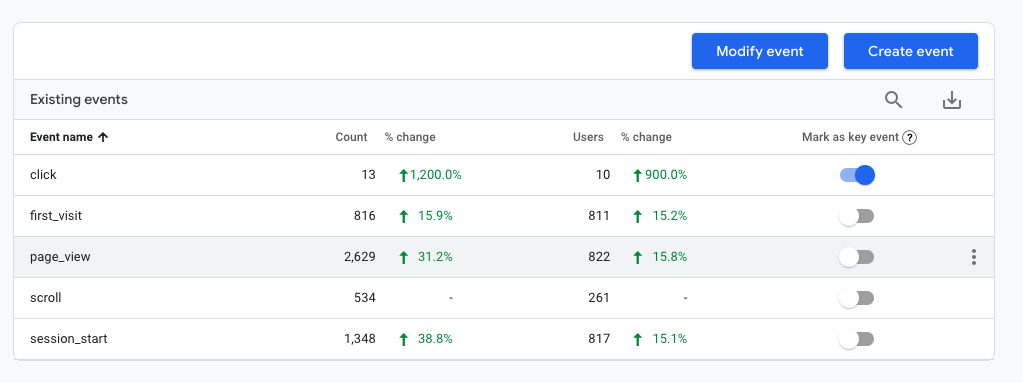
3. Implement Custom Conversions
As previously mentioned, the enhanced measurement tools are crucial for a lot of businesses to immediately get a better understanding of their data but they are limited, particularly in terms of creating specific conversions for different forms. These are fairly easy to set-up and give you some level of more detailed information without needing to use tools like Google Tag Manager. It should be noted that you should consider
For example, we are looking to set up a conversion for every time a user completes a quiz. Due to how this campaign works, they can one of 4 different results and we want to be able to track each completion based on what they got as their result. For this example, we will be setting up a conversion for when a user gets the result ‘marketer’ for one of our campaigns, easily repeatable for the other options. The ‘marketer’ result will send them to a page with the slug /thank-you-marketer so here are the steps for setting up this key event in Google Analytics 4 :
- Go to the Events tab in Settings and click ‘create event’.
- In the Custom event name field, enter the event name ‘generate_lead_ marketer’
- In the Matching conditions section, enter the condition ‘event_name equals page_view’.
- Enter the condition ‘page_location equals https://axonpoint.co.uk/thank-you-marketer’.

- In Admin, under Data display, click Key events.
- Click New key event.
- Enter the name of the new event you’ve just set up.
- Ensure that the event is in the menu and toggled as a key event.

4. Leverage Audiences for Targeting
GA4 enables you to create audiences based on user behaviour and these can be really helpful for e-commerce businesses. You can find these under Data Display in the settings. You can use these audiences to better understand certain types of customers and see how campaigns such as abandon baskets are performing. For example, you can create an audience of users who added items to their cart but didn’t complete the purchase. By retargeting these users with tailored ads, you can increase the likelihood of conversion.
5. Monitor and Analyse Data
Once you’ve got your groundwork set up, you need to keep tabs on it. Regularly monitoring and analysing your conversion data is essential for ongoing optimisation. Look for patterns in user behaviour, conversion rates, and campaign performance. This continuous analysis will help you make informed decisions and refine your strategies over time.
Conversion tracking is a critical component of any successful business strategy. By understanding customer behaviour, optimising marketing campaigns, and measuring success, you can drive growth and improve your ROI. For small businesses looking to thrive in today’s competitive landscape, mastering conversion tracking is a must. By following these steps, you’ll gain valuable insights into your business’s performance and make data-driven decisions that propel your growth.
Want to see how your business stacks up? Claim your free conversion tracking review today, provided by our expert team. We have experience working with lots of different businesses, supporting them with getting a better understanding of their data and how to maximise their ROI and we’d love to help you bring your business to the next level.
What is Google’s BERT Algorithm and How is it Impacting Business
If you follow much in the world of digital marketing and the undisputed search god that is Google, you may be familiar with the many acronyms from ALT tags to SERPs and E-A-T (now E-E-A-T) to CWVs (Core Web Vitals) that help us all navigate and understand what makes it tick. A unique beast that you may not be familiar with is the B-E-R-T algorithm otherwise known under the catchy name of Bidirectional Encoder Representations from Transformers.

In the modern age of AI developments, an AI algorithm from 2019 might seem pretty prehistoric but B-E-R-T has been a major force in how you experience and deal with Google search for 5 years now and still being actively developed by Google with the latest version TW-BERT being announced last year.
What is the BERT algorithm?
The BERT algorithm is a natural language processing algorithm designed to apply added context to your search. When you enter anything into Google, your search can be interpreted several different ways. For example, if you were to search ‘bark’, it could be for tree bark, wood chips, a dog’s bark or even BBQ bark from brisket.
It’s BERT’s job to understand your search by using the surrounding words to provide the necessary context and it was designed to improve its understanding of our search habits over time to become even better at providing relevant search results for the queries we provide.
How does BERT impact search?
BERT was designed to provide context to words and to essentially connect the dots. This was incredibly helpful for Google search, where previously Google had struggled to provide relevant search results for their users and would often provide searches for every word in your search, regardless of your actual intent. For example, a search for ‘apple store’ was just as likely to provide you with local orchards as it was the latest in tech innovation.
BERT streamlined this across all elements of Google search, allowing for an easier overall experience for users. This meant heavy changes to how things like the local pack worked. No longer would Google showcase a local pack for every term but they would only show local packs for relevant terms. For example, ‘best car dealer in Nottingham’ and not ‘how to sell a car quickly in Nottingham’. This hasn’t always been perfect and has meant that certain deserving search terms have lost local pack rankings which has impacted businesses. However, it does mean that local search is a more powerful tool than it was before.

Another key area that was impacted was featured snippets. These are little snippets of content that are highlighted at the top of Google, usually in response to query based searches such as ‘how can I build muscle?’. BERT allowed these snippets to be far more representative of the actual search query and this meant that the more detailed the search query, the more precisely tailored your featured snippet would be, providing the end user with a quick answer and giving the business with the most relevant information a major boost in the rankings.
The change that BERT created essentially meant that the relevance of your content was most important and this meant that businesses that created content with the end user in mind came up on top while businesses looking to rig the system and simply dominate the results through ungentlemanly tactics were left struggling for air.
How does this impact your business?
BERT provided a massive shakeup to Google’s search rankings at the time and is a key ranking tool for Google today. By and large, Google is now providing more relevant search queries than ever before and this has pros and cons for your business in terms of how they are found in Google.
On the positive side, your business is now more likely to be found for the things you actually want to be found for. This means a higher chance of being found by your ideal audience and better chance of actually securing the sale. As mentioned above, it also meant that local search was now far more powerful and prominent in Google’s algorithm, which means that local businesses that provide quality local content can reach their ideal audience easier and typically it means that they can rank for terms they’d be unlikely to otherwise due to general competition.
On the negative side, it is now typically harder to rank for those major terms and your content needs to be on point. Long waffle designed to do nothing but cram in keywords is no longer going to cut it. BERT also means that businesses that have options for a specific niche but don’t specifically target that niche might struggle against businesses with more dedicated content. For example, a hotel that has a few dog friendly rooms might struggle to rank for ‘places to stay with a dog’ over somewhere that is purely dog friendly and called ‘Paws Doors’.

How to ensure your business is suited for BERT and Google
To protect your business from losing rankings due to BERT, it’s crucial to scrutinise your keyword performance and enhance your keyword choices. If you notice drops in key areas, it is likely that your content may not be particularly relevant for that niche or it could be that you simply don’t have enough content. Look into key queries for your customers using tools such as answerthepublic and start to add more locally focused keywords to your list to help you improve your visibility in key areas.
To support this, focus on optimising the relevancy of your Google Business Profile. The BERT update has been particularly impactful on local business rankings, so it’s essential to ensure your GBP profile is up to date and relevant. To do this, make sure to add localised images and user-generated local queries with answers to your GMB profile to increase its relevance.
Another critical step is to rectify any unnatural content on your site and drive relevant traffic. Review the pages that have dropped in rankings and check for unnatural keyword usage and readability issues. To benefit from the BERT update, start building long-form, valuable content that addresses common queries in your niche with natural internal links threaded through the content to allow for a better user experience. Keeping this in mind, including FAQs and using simple subheadings can make your content more engaging and relevant, helping it rank higher and making it more valuable for featured snippets.
How is BERT impacting the rise of AI?
It’s no secret that AI content has been the big thing to sweep digital content over the past few years and as one of the main content sources on the planet, it has impacted Google especially hard. Google has been incredibly proactive in terms of stomping out content they believe to be AI driven and deindexing a wide variety of sites (some of which were highly established) they deem to be making use of this content. Now, how much Google can really track AI content and how much they really want to snuff it out is up for debate; with the constant implementation of AI in Google’s search engine and the development of things such as Google Bard.
However, their commitment to high quality content is consistent with their overall message of prioritising user experience over just spamming content. How does BERT relate to all this? Well, BERT isn’t necessarily designed to track content, it’s designed to track user search to recommend the most appropriate content. However, BERT’s ability to understand context means that websites employing natural language and context-rich content tend to perform better in search results. This algorithm rewards high-quality, informative content. As a result, websites featuring well-researched, comprehensive articles are more likely to achieve higher rankings in search results.
So, the game hasn’t really changed with AI. Well-formatted, user-driven content is always going to perform better than content for content’s sake. This doesn’t mean that AI is strictly forbidden by Google but it does mean that you need to repurpose and retool what you get out of AI to make it more natural and user-focused, with the right headings and context.
Despite the changes brought by the BERT update, maintaining strong local SEO best practices remains crucial to help your business rank. By consistently applying the strategies above, you can mitigate the impact of the BERT update and maintain strong search engine rankings for your business even as Google continues to deal with the impact of AI content.
If you require support in understanding how to tailor your content towards BERT or simply want to get higher up those rankings, we can support you with content-driven local SEO marketing. With our proven track record, we can help up soar at the very top of those google rankings just in time for Google’s next game breaking algorithm.
How to Add Users to Google Analytics and Google Business Profile
Welcome to the digital age! Just as you might delegate responsibilities in a bustling kitchen to ensure every dish turns out perfect, adding users to your Google Analytics and Google Business Profile can help you manage your online business more efficiently. Here’s how you can expand your digital marketing team without the hassle.
Part 1: Adding Users to Google Business Profile
Google Business Profile is a powerful tool that helps you manage your online presence across Google, including Search and Maps. It’s an easy to use tool that is incredibly collaborative so making effective use of different users is a must. Here’s your step-by-step guide to adding new users:
Step 1: Log In
Begin by logging into your Google Business Profile account at business.google.com or by selecting the ‘Business Profile Manager’ icon from the Google Apps menu if you’re signed into your Google account.
Step 2: Navigate to Profile Settings
Look for the three dots located at the top right of the profile manager menu and click them to access your profile settings.
Step 3: Select ‘People and Access’
From the Business Profile Settings menu, choose the ‘People and access’ option to manage who can view and edit your business information.
Step 4: Add a New User
Hit the ‘Add User’ button, then enter the email address of the individual you wish to give access to.
Step 5: Set Permissions and Invite
After entering the email address, select the ‘manager’ option from the role choices and click ‘Invite’. The invitee will receive a notification from Google Support to accept access.
Part 2: Adding Users to Google Analytics
Google Analytics allows you to track and analyse traffic on your website, offering insights that are crucial for your digital marketing strategy. Let’s go through the steps to bring more members into your Google Analytics account.
Step 1: Log Into Google Analytics
Sign in to your or your client’s Google Analytics account.
Step 2: Choose the Correct Account
Select the relevant property/account from the dropdown menu located in the top right of the main screen.
Step 3: Access Settings
Click on the ‘settings cog’ located in the bottom right corner of the interface (imagine it as the hidden door to your marketing fortress).
Step 4: Go to Account Access Management
Navigate to ‘Account Access Management’ to start adding new users.
Step 5: Add Users and Set Access Levels
Enter the email addresses of the users you want to add and nominate the level of access for each.
Once added, the user will receive an email from Google Support with an invitation to accept access, making them a part of your marketing guild.
Managing Permissions
When managing user permissions, it’s vital to only grant access levels that users need to perform their tasks. Regular audits of user roles and permissions can help keep your accounts secure and functioning smoothly.
Congratulations! You’re now ready to expand your digital marketing team with ease. By adding trusted users to both Google Analytics and Google Business Profile, you empower your business with diverse insights and increased operational efficiency.
Looking for a more detailed resource or simply something to share with colleagues and clients? Our downloadable guides are available down below to provide you with easy step-to-step guides that are easily shareable with lots of lovely images!
The Risks of ‘Turning Off’ SEO for Small Businesses and E-Commerce

In the digital age, Search Engine Optimization (SEO) is not just a buzzword; it’s a pivotal element of online visibility and business success. For small business owners and e-commerce sites, mastering SEO means ensuring a prominent spot in the ever-competitive digital marketplace. But what happens when the SEO wheel stops turning? Is it a mere pause, or does the journey backward begin? This article delves into the critical consequences of turning off your SEO, highlighting why it’s a continuous journey rather than a temporary sprint.
Immediate Impacts of Stopping SEO
The moment SEO efforts cease, the immediate repercussions begin to surface, subtly at first, then increasingly pronounced. Initially, your website’s traffic might not drop, but the signs of decline are imminent. Key indicators like search ranking positions start to slip, as meticulously chosen keywords lose their stronghold. This decline is more than a mere statistical concern; it’s the opening for competitors to climb the rankings, occupying the space you once held.
Moreover, the dynamic nature of search engines means they continually crawl and reassess websites. Without fresh, SEO-optimised content, your site gradually loses relevance in the eyes of these digital arbiters. The result? A slow but steady erosion of the online presence you’ve worked hard to build. This immediate impact is just the tip of the iceberg, signalling deeper issues that unfold over time.
Long-Term Consequences for Website Performance and Search Rankings
The long-term effects of pausing SEO are more profound and far-reaching. Over time, the absence of consistent SEO efforts manifests in a significant decline in organic traffic. Your website, once a bustling hub of visitor activity, begins to fade into obscurity as it moves down search engine results pages (SERPs). This decline in visibility directly impacts your website’s performance, as fewer visitors translate to fewer opportunities for engagement, leads, and conversions.
Moreover, the cumulative impact on your website’s domain authority is notable. Domain authority, a measure of your site’s credibility and relevance, is crucial for search rankings. Without regular updates, high-quality content, and ongoing optimization, this authority diminishes, making it increasingly challenging to compete in SERPs.
Another crucial aspect is the frequency of search engine algorithm updates. Search engines like Google constantly evolve, refining how they evaluate and rank websites. Regular SEO keeps your site aligned with these changes, ensuring adaptability and relevance. Without this ongoing effort, your site becomes more susceptible to being negatively impacted by these updates, further compounding the decline in rankings and visibility.
Common Misconceptions About SEO Duration
A prevalent myth in the digital marketing world is that SEO is a set-and-forget strategy. Many believe that once top rankings are achieved, the job is done. This misconception overlooks the dynamic and competitive nature of search engines. SEO is not a one-time project; it’s an ongoing process. Search engines continually update their algorithms, competitors adjust their strategies, and consumer behaviours evolve. Staying ahead in this ever-changing landscape requires persistent optimization and adaptation. By understanding that SEO is a continuous journey, businesses can better prepare for sustained online success.
Ongoing SEO, Algorithm Updates, and Digital Marketing Success

Ongoing SEO is not just about maintaining rankings; it’s about thriving in a digital ecosystem that’s in constant flux. Regular SEO activities enable businesses to quickly adapt to search engine algorithm updates, which can otherwise catch unprepared websites off-guard. This adaptability is crucial for sustaining and improving search rankings over time. Furthermore, continuous SEO efforts are integral to a holistic digital marketing strategy. They enhance other aspects like content marketing, social media presence, and user experience, creating a synergistic effect that drives overall digital success. In essence, ongoing SEO is the lifeblood of a dynamic and resilient online presence.
Turning off SEO is like taking a break in a race that never stops, you’re making it easy for your competitors to get ahead of you. Continuous investment in SEO is essential for enduring digital success, keeping your business relevant, competitive, and visible. Embrace SEO as a perpetual journey, and it will steer your business towards sustained growth and online prominence.
The Benefits of Blogging

Blogging in 2024: More Than Just Words
Welcome to the dynamic world of blogging in 2024! Gone are the days when blogs were just digital diaries. Today, they are powerful tools for storytelling, sharing knowledge, and building communities. As we navigate through this article, we’ll explore how blogging has not just survived but thrived in the modern digital era, transforming into a key component of effective SEO strategies. So, buckle up and let’s dive into the fascinating evolution of blogging in 2024!
The Current State of Blogging in 2024
Evolution: From Text to Multimedia Mastery
In 2024, blogging has transformed significantly, adapting to the ever-evolving digital landscape. Initially serving as text-based platforms, blogs have now embraced multimedia elements, catering to audiences with diverse preferences. This shift is a response to changing search engine algorithms and reader behaviours. Quality content, enriched with engaging multimedia, is now at the forefront, enhancing user experience and establishing brand authority.
Statistics Speak: Blogging’s Unwavering Relevance
Despite the rise of various online content forms, the significance of blogging remains unwavering. With over 600 million blogs globally, blogging continues to be a pivotal tool for digital marketing. Key metrics like organic traffic and search rankings are the primary success measures, highlighting the integral role of SEO. Bloggers committed to keyword research and analytics monitoring are seeing stronger results, showcasing the direct impact of strategic SEO practices.

Blogging and SEO: A Symbiotic Relationship
The Lifeline of Modern Blogs: SEO
In 2024, the bond between blogging and Search Engine Optimization (SEO) is stronger than ever. The effectiveness of a blog is now deeply intertwined with its SEO strategy. Quality content is king, but it reigns supreme only when paired with smart SEO. This involves creating content that not only engages but also meticulously aligns with what search engines favour: informative, authoritative, and user-friendly posts.
Optimising for Visibility and Engagement
A successful blog today goes beyond just writing; it’s about crafting content that’s both discoverable and captivating. This means integrating SEO best practices, such as using strategic keywords, creating compelling meta descriptions, and ensuring mobile responsiveness. Bloggers are also leveraging a variety of content types – from text and images to videos and podcasts – to enhance user engagement and improve search rankings.
Best Practices for Effective Blogging in 2024
Crafting Quality Content: The Heart of Blogging
In the rapidly evolving world of 2024, quality reigns supreme in the blogosphere. Creating content that resonates with your audience involves more than just writing; it’s about delivering value. This means well-researched, informative, and engaging posts that not only inform but also entertain your readers. It’s the blend of information and personality that makes your content stand out.
Engaging and Building a Community
A blog is not just a platform; it’s a community. Engaging with your audience through comments, social media, and real-time interaction tools fosters a sense of belonging and loyalty. Encourage user-generated content and collaborations to create a richer, more diverse content landscape. This approach not only enhances the user experience but also strengthens your blog’s presence and authority.

Expert Insights on the Future of Blogging
Monetization: The Evolving Landscape
In 2024, the art of monetizing a blog has become more sophisticated and diverse. Traditional advertising methods have evolved, making way for sponsored content and influencer marketing. Subscription models and paywalls have gained traction, allowing bloggers to offer premium content to their dedicated audience. Additionally, the integration of cryptocurrency and blockchain-based platforms offers new avenues for revenue generation. These emerging trends not only sustain the passion for content creation but also open doors to innovative monetization strategies.
Blogging as a Social and Community Platform
Experts emphasise viewing blogs not just as content-sharing platforms but as community and social hubs. Integrating real-time interaction tools, focusing on audience engagement, and fostering connections with fellow bloggers are pivotal. This shift enhances the sense of community and makes blogs more than just information repositories. They become lively, interactive spaces where ideas and conversations flourish.

Success Stories: Blogging Achievements in 2024
Trailblazers in the Blogging World
The financial potential of blogging in 2024 is more evident than ever. Successful bloggers like Matthew Kepnes of ‘Nomadic Matt’ and Michelle Schroeder-Gardner have showcased the immense earning potential, with annual earnings reaching up to $750,000 and monthly earnings around $100,000, respectively. These success stories exemplify the lucrative nature of blogging when combined with the right strategies, including effective monetisation, quality content, and strong SEO practices.
A Testament to Blogging’s Viability
These achievements serve as a testament to the viability and strength of blogging in the current digital era. They not only highlight the financial rewards but also demonstrate the power of blogging as a platform for personal branding, thought leadership, and community building.
Embracing the Blogosphere of Tomorrow
As we conclude our journey through the blogging landscape of 2024, it’s clear that blogging is not just surviving; it’s thriving. Its ability to adapt to the changing digital environment, coupled with its enduring value in fostering connections and amplifying diverse voices, cements its place in the future of digital marketing.
The Path Forward
The path forward for aspiring bloggers is marked with opportunities for creativity, innovation, and community building. By embracing the evolving trends, adapting to new technologies, and maintaining a focus on quality and engagement, the future of blogging looks bright and promising.
Thank you for embarking on this exploration of blogging in 2024 with us. May your blogging journey be filled with success, innovation, and connection!
4 Steps to improving rankings and traffic to your blog
We have many tactics and tools in our ever-expanding marketing locker but the most consistent trick at our disposal is content. In the ever-changing landscape of digital marketing, blogs and articles remain a critical tool for engaging audiences and driving organic traffic to websites and this is true across almost all industries. From sports brands to funeral directors, we’ve seen the impact of an effective blog campaign on the overall health and performance of organic traffic.
However, maintaining a successful blog isn’t just about creating new content; it also involves making the most of your existing articles. In fact, reviewing old blog content can often be a more effective use of time and resources than spending time researching, writing and then publishing a new written piece. Old blog content, if strategically utilised, can breathe new life into your website and significantly impact your overall content marketing strategy. End of the day, it’s already there so it might as well perform as well as it can for you or it’s just wasted hours. We recently ran through the below steps for a sports nutrition brand with over 50 blog posts and we wanted to share our process as well as what we had learned by combining our top 2 marketing tools, content and data analysis.
We’ll explore the art of using data to revive old blog content, turning it into a powerful asset that drives traffic, boosts SEO rankings, and rekindles audience interest without making major changes to the actual content of the posts. While it sounds complicated, this straightforward process can help you assess how your content is actually performing and where the opportunities for improvement are.
- Analysing Traffic Metrics

The first step in reviving old blog content is to analyse traffic metrics using various website analytics tools. Identify articles that once generated substantial traffic but may have lost visibility over time or where any recent uplifts have come from. Focus on high-performing posts that have the potential to regain traction and attract new audiences. The key to this is having a large enough dataset (at least 6 months but preferably a year or more to get enough clear data).
Start by evaluating metrics like page views, time on page, bounce rate, and organic search traffic for each blog post. This data will help you prioritise which articles to revive, as well as provide valuable insights into the preferences of your target audience. It’s also important to look at exit pages as well as user journeys. If a user clicked on a blog post, where did they go afterwards? Where did you eventually lose them?
2. Identifying Evergreen Topics & Understanding Topical Content
The key to any blog creation is understanding what content is actually on your blog. For the most part, this will fall under two categories : topical or evergreen. Not all blog posts age equally. Evergreen content, which remains relevant and valuable regardless of the publishing date, holds great potential for revival. Identify evergreen topics that are still relevant to your niche and target audience. By updating and republishing these articles, you can tap into ongoing search interest and engage new readers with timeless content.

This doesn’t mean that topical content is necessarily a lost cause. While one-time only events may not showcase continual value to users, there is often an opportunity to revamp the content without drastically changing it. Things like yearly bucket lists or seasonal challenges can be worked around to provide topical content that is still providing more evergreen value.
3. Keyword and Competitor Research for Optimisation
Keyword research is a crucial aspect of any content strategy, and the same applies to revitalising old blog posts. Utilise keyword research tools to identify relevant and trending keywords related to your blog’s focus. Incorporate these keywords strategically into your old posts to improve their visibility in search engine rankings. By optimising content for popular search terms, you increase the chances of driving organic traffic to your revamped articles. This is a process that can be easily chipped away at but knowing where to make the changes and why is important.

It is also important to look at what your competitors are doing. If you have a competitor that is performing well for your key terms and potentially stealing your base, you need to be prepared to steal it back. Look at their key terms with tools like Ahrefs or SERanking and see where their traffic is coming from and where you can make changes to cut them off at the pass. This can also be useful for identifying their content areas of focus and seeing what makes you different as well as considering what areas you are currently missing. While not necessarily revamping your old blog content, you can still sometimes find ways that similar content is framed differently for bigger results. For example, targeting ‘fitness challenges’ over ‘sport challenges’ or ‘sporting bucket list’. If your competitor is outperforming you, there is likely a reason for it and if you have similar content, have a look to see what they are doing well.
4. Refreshing and Enhancing Content
Once you’ve identified the blog posts to revive and the relevant keywords to target, it’s time to refresh and enhance the content. Now the most obvious area to expand is in the content and you can do this by updating statistical data, outdated information, and broken links to improve the overall accuracy and credibility of the posts. Additionally, adding new insights, examples, or case studies to make the content more valuable to readers.
However, this is time consuming and there are other ways to refresh your content without actually making any real changes to the copy or data. Refer back to your data. What did it tell you? If you have a high bounce rate, this would suggest users aren’t being compelled to stay for whatever reason. You can look to address this by improving CTAs across the blog post and ensuring a clear next step.

If users are continually looking at blog content but not really moving to the next step in terms of sales or enquiries, maybe look at ways to nurture them and pull them towards that next step. That’s not to say you should treat blog content as a sales method. Blog content is primarily a way of improving brand visibility and awareness while also building your reputation but if someone is staying for 10+ minutes and only reading content, that’s a good sign you’ve got an engaged base who maybe need a little push in the right direction.
Another example of how data can help you address old blog content is by looking at similar categories. It is often the case that blog content comes in clusters. This is a solid SEO strategy that we have used to great effect over the years. This can be effective for many reasons but it can also significantly help with showcasing your priorities. For example, if you have 10 pieces of content on dog beds and only your ‘dog beds for small dogs’ article seems to be performing well then it might be necessary to review what you did differently in that post as well as using that post to divert traffic to your other articles. With cluster-type content, it is quite common for one or two pieces of content to outperform the rest as these will act as central hubs but if a piece of content you don’t expect is outperforming the rest, it is a good sign that you need to review your approach and make a change.
Reflection
A blog audit that involves reviving old blog content using data-driven strategies can yield remarkable results for your content marketing efforts. By analysing traffic metrics, identifying evergreen topics, reviewing competitor research and refreshing content based on those findings, you can transform outdated articles into valuable assets that continue to attract audiences and boost SEO rankings.
Reviving old blog posts not only saves time but also ensures that your content library remains evergreen, offering timeless value to both new and returning readers. Embrace the power of data in your blog audit and witness your content’s revival spark new interest and drive consistent traffic to your website.
Don’t hesitate to contact us to talk to one of our dedicated team members for more insight.
9 Strategies to Market Your Independent Business Like a Pro
Welcome to the wild world of startup and small business marketing, where every penny counts and creativity is your best friend! You’ve got a groundbreaking idea—that’s fantastic. But guess what? Without a clever way to shout it from the digital rooftops, you might as well be whispering in a hurricane. Enter content marketing: your cost-effective megaphone to the masses.
Think of content marketing as a buffet of choices to get your message across. From tantalising blog posts to engaging podcasts, snazzy newsletters to social media shenanigans, and videos to infographics that make data look sexy—there’s a flavour for every startup palate and budget. And the cherry on top? These strategies don’t require you to sell your grandma’s heirlooms to afford them.
So, you’re pinching those pennies and wondering how to catapult your startup into the limelight without breaking the bank. Fear not, for we’ve conjured up 9 cheeky yet effective ways to leverage content marketing, regardless of whether your wallet is stuffed or starving. Not every tactic will be your cup of tea, but hey, variety is the spice of life, right?
1. Become a Blogging Beast

A blog is the Swiss Army knife of the content world—versatile, powerful, and perfect for showing off your industry smarts. Running a cybersecurity circus? Dazzle your audience with tales of digital heroism against phishing villains. Blogs are your stage to solve the audience’s problems while subtly hinting, “Psst, we’ve got what you need.” And if you’re worried about cost, remember: words are free, and your wisdom is priceless.
For more blogging tips and tricks click here
2. Gatecrash the Guest Posting Party
Guest posting is like being invited to speak at someone else’s party. It boosts your rep, spreads your gospel, and tells Google you’re the next big thing. Just make sure you’re partying with the cool kids (a.k.a. reputable sites). It’s all about mingling in the right circles where your tales of culinary conquests or tech triumphs resonate.
3. Obsess Over SEO Like It’s Your New Crush
SEO isn’t just a buzzword; it’s your secret weapon to serenade Google and woo your ideal customers. Think of it as the matchmaking app of the internet. Use tools like Answer the Public to find out what tickles your audience’s curiosity, then craft content that answers their burning questions. Remember, great SEO is like a good relationship: it needs attention, respect, and a bit of hard work.
Our simple strategies are typically split across these 6 areas
4. Get to Grips with Google Business Profile
GMB (Google My Business), also called GBP or Google Business Profile, is a handy free tool for businesses to handle their online visibility on Google platforms like Google Maps and Google Search. It’s like your brand’s friendly face on Google! Pairing it with local SEO boosts your chances of popping up in local search results, often known as the Local Pack.
Get your Free step by step Google Business Profile guide here
5. Unleash Your Inner Picasso with Visual Content
Who said a picture’s worth a thousand words didn’t know about infographics. They can convey complex data with the grace of a ballet dancer and the impact of a heavyweight boxer. And for the budget-conscious, tools like Canva are like finding a designer suit at a thrift shop—top-notch results without the price tag.
6. Make Social Media Your Bestie
Social media is the friend who knows everyone and can get you into any party. It’s where you show off your brand’s personality, connect with your tribe, and share content that gets people talking. And the best part? It’s freer than a bird. No excuses, folks. Start tweeting, posting, and sharing your heart out.
7. Dive Into the Buzz of Your Industry
Stuck on what to talk about? Jump into the hottest industry goss like a reality TV star diving for drama. Whether it’s the latest tech breakthrough or the cost of living crisis, showing you’re in the know builds credibility and engages your audience. Plus, it proves you’re not living under a rock.
8. Automate Your Emails Like They’re Going Out of Style
Email marketing: it’s not just alive, it’s kicking and screaming for attention. With automation tools, you can send personalised love letters to your audience without lifting a finger. Well, maybe a little finger lifting at the start, but then it’s smooth sailing. Set up, kick back, and watch your engagement soar.
Boost your open and click rates from email marketing with these tips
9. Flaunt Your Successes Shamelessly
Got a happy customer? Turn that success story into content gold with testimonials and case studies. It’s like showing up to a networking event with an entourage of fans—impressive and convincing. Don’t be shy; ask for those accolades and showcase them like the trophies they are.
Running an independent business without content marketing is like hosting a party and forgetting to invite guests. Sure, you’ve got a great venue (your product), but without guests (your audience), it’s just sad. These cost-effective strategies are your invitations to the world, proving you don’t need a Silicon Valley budget to make a big splash. And if you find yourself drowning in content creation despair, remember, help is just a call away. So, what are you waiting for? Get creative, be bold, and start marketing like a boss on a budget.
Here are some examples of our digital marketing success stories
For more content tips and cost effective strategies, give us a shout…
Mastering the Art of Responding to Negative Google Reviews
In the digital age, online reviews wield significant influence over a business’s reputation. While positive reviews can be uplifting, negative feedback can feel like a setback. However, responding to negative reviews is an opportunity to showcase your brand’s commitment to customer satisfaction. In this guide, we’ll explore effective strategies on how to respond to negative reviews, accompanied by real-world examples.

Introduction: The Power of Responding to Negative Reviews
Negative reviews, though disheartening, provide a chance to turn the situation around. A well-crafted response not only addresses the specific concerns of the reviewer, but also demonstrates to potential customers that your business values feedback and is dedicated to resolving issues.
1. Promptness Matters
Responding promptly to negative reviews is crucial. Acknowledge the review as soon as possible to show that you take customer feedback seriously. For instance:
“Thank you for bringing this to our attention. We apologise for any inconvenience caused and are actively looking into the matter to address your concerns.”
2. Personalise Your Responses
Avoid generic responses; instead, tailor your reply to the specific concerns raised. Personalization shows that you genuinely care about each customer’s experience. For example:
“Dear [Reviewer’s Name], we’re sorry to hear about your experience. We’d like to learn more about what happened. Please contact us at [customer service email or phone number] so we can address your concerns directly.”
3. Stay Professional and Polite
Maintain a professional and courteous tone in your responses, regardless of the nature of the review. Responding defensively can escalate the situation. Here’s an example:
“We appreciate your feedback and apologise for any inconvenience. We understand your frustration, and we’re committed to resolving this matter. Please contact our customer service team at [contact details] so we can assist you further.”
4. Take the Conversation Offline
When dealing with sensitive issues, it’s often best to move the conversation out of the public eye. Provide alternative contact details and encourage the reviewer to continue the discussion privately. For instance:
“We’re sorry to hear about your experience. To discuss this matter further and address your concerns, please reach out to us directly at [customer service email or phone number]. We look forward to resolving this issue together.”
5. Showcase Positive Changes
If applicable, use negative reviews as an opportunity to highlight improvements or changes your business has made. This shows that you listen to feedback and actively work towards bettering your services. For example:
“We appreciate your feedback, and we’ve taken steps to address the issues you’ve raised. We value your input, and we’re committed to providing an even better experience in the future.”
Conclusion: Turning Criticism into Opportunity
Responding to negative reviews is an essential aspect of reputation management. By addressing concerns promptly, personally, and professionally, you not only demonstrate your commitment to customer satisfaction but also showcase your brand’s transparency and accountability.
Remember, every negative review is a chance to learn and grow. Embrace the opportunity to turn dissatisfied customers into loyal advocates by showcasing your dedication to continuous improvement.
By implementing these strategies and utilising the provided examples, you can navigate the delicate art of responding to negative reviews, fostering a positive online reputation for your business.
Using Data To Refresh Old Blog Content
We have many tactics and tools in our ever-expanding marketing locker but the most consistent trick at our disposal is content. In the ever-changing landscape of digital marketing, blogs and articles remain a critical tool for engaging audiences and driving organic traffic to websites and this is true across almost all industries. From sports brands to funeral directors, we’ve seen the impact of an effective blog campaign on the overall health and performance of organic traffic.

However, maintaining a successful blog isn’t just about creating new content; it also involves making the most of your existing articles. In fact, reviewing old blog content can often be a more effective use of time and resources than spending time researching, writing and then publishing a new written piece. Old blog content, if strategically utilised, can breathe new life into your website and significantly impact your overall content marketing strategy. End of the day, it’s already there so it might as well perform as well as it can for you or it’s just wasted hours. We recently ran through the below steps for a sports nutrition brand with over 50 blog posts and we wanted to share our process as well as what we had learned by combining our top 2 marketing tools, content and data analysis.
We’ll explore the art of using data to revive old blog content, turning it into a powerful asset that drives traffic, boosts SEO rankings, and rekindles audience interest without making major changes to the actual content of the posts. While it sounds complicated, this straightforward process can help you assess how your content is actually performing and where the opportunities for improvement are.
1. Analysing Traffic Metrics
The first step in reviving old blog content is to analyse traffic metrics using various website analytics tools. Identify articles that once generated substantial traffic but may have lost visibility over time or where any recent uplifts have come from. Focus on high-performing posts that have the potential to regain traction and attract new audiences. The key to this is having a large enough dataset (at least 6 months but preferably a year or more to get enough clear data).
Start by evaluating metrics like page views, time on page, bounce rate, and organic search traffic for each blog post. This data will help you prioritise which articles to revive, as well as provide valuable insights into the preferences of your target audience. It’s also important to look at exit pages as well as user journeys. If a user clicked on a blog post, where did they go afterwards? Where did you eventually lose them?
2. Identifying Evergreen Topics & Understanding Topical Content
The key to any blog creation is understanding what content is actually on your blog. For the most part, this will fall under two categories : topical or evergreen. Not all blog posts age equally. Evergreen content, which remains relevant and valuable regardless of the publishing date, holds great potential for revival. Identify evergreen topics that are still relevant to your niche and target audience. By updating and republishing these articles, you can tap into ongoing search interest and engage new readers with timeless content.
This doesn’t mean that topical content is necessarily a lost cause. While one-time only events may not showcase continual value to users, there is often an opportunity to revamp the content without drastically changing it. Things like yearly bucket lists or seasonal challenges can be worked around to provide topical content that is still providing more evergreen value.
3. Keyword and Competitor Research for Optimisation
Keyword research is a crucial aspect of any content strategy, and the same applies to revitalising old blog posts. Utilise keyword research tools to identify relevant and trending keywords related to your blog’s focus. Incorporate these keywords strategically into your old posts to improve their visibility in search engine rankings. By optimising content for popular search terms, you increase the chances of driving organic traffic to your revamped articles. This is a process that can be easily chipped away at but knowing where to make the changes and why is important.
It is also important to look at what your competitors are doing. If you have a competitor that is performing well for your key terms and potentially stealing your base, you need to be prepared to steal it back. Look at their key terms with tools like Ahrefs or SERanking and see where their traffic is coming from and where you can make changes to cut them off at the pass. This can also be useful for identifying their content areas of focus and seeing what makes you different as well as considering what areas you are currently missing. While not necessarily revamping your old blog content, you can still sometimes find ways that similar content is framed differently for bigger results. For example, targeting ‘fitness challenges’ over ‘sport challenges’ or ‘sporting bucket list’. If your competitor is outperforming you, there is likely a reason for it and if you have similar content, have a look to see what they are doing well.
4. Refreshing and Enhancing Content
Once you’ve identified the blog posts to revive and the relevant keywords to target, it’s time to refresh and enhance the content. Now the most obvious area to expand is in the content and you can do this by updating statistical data, outdated information, and broken links to improve the overall accuracy and credibility of the posts. Additionally, adding new insights, examples, or case studies to make the content more valuable to readers.
However, this is time consuming and there are other ways to refresh your content without actually making any real changes to the copy or data. Refer back to your data. What did it tell you? If you have a high bounce rate, this would suggest users aren’t being compelled to stay for whatever reason. You can look to address this by improving CTAs across the blog post and ensuring a clear next step.
If users are continually looking at blog content but not really moving to the next step in terms of sales or enquiries, maybe look at ways to nurture them and pull them towards that next step. That’s not to say you should treat blog content as a sales method. Blog content is primarily a way of improving brand visibility and awareness while also building your reputation but if someone is staying for 10+ minutes and only reading content, that’s a good sign you’ve got an engaged base who maybe need a little push in the right direction.
5. Create Content Clusters
Another example of how data can help you address old blog content is by looking at similar categories. It is often the case that blog content comes in clusters. This is a solid SEO strategy that we have used to great effect over the years. This can be effective for many reasons but it can also significantly help with showcasing your priorities. For example, if you have 10 pieces of content on dog beds and only your ‘dog beds for small dogs’ article seems to be performing well then it might be necessary to review what you did differently in that post as well as using that post to divert traffic to your other articles with internal links. With cluster-type content, it is quite common for one or two pieces of content to outperform the rest as these will act as central hubs but if a piece of content you don’t expect is outperforming the rest, it is a good sign that you need to review your approach and make a change.
Recap
A blog audit that involves reviving old blog content using data-driven strategies can yield remarkable results for your content marketing efforts. By analysing traffic metrics, identifying evergreen topics, reviewing competitor research and refreshing content based on those findings, you can transform outdated articles into valuable assets that continue to attract audiences and boost SEO rankings.
Reviving old blog posts not only saves time but also ensures that your content library remains evergreen, offering timeless value to both new and returning readers. Embrace the power of data in your blog audit and witness your content’s revival spark new interest and drive consistent traffic to your website.
The Value of Internal Links : Maximising Link Value
When thinking about links in SEO, most people immediately divert to ‘backlinks’. The proverbial gold dust of SEO and digital marketing, backlinks are an incredibly valuable resource for helping your site get found by Google and other users. However, they are not the only important links that you can and should make use of in your digital marketing strategy.
Internal links are an often overlooked resource in the digital marketing space as there is no ‘direct’ impact to their use. Internal links have a lot of unique value as a tool in any SEO’s kit but compared to the impact of backlinks, their worth is more subtle. This article serves as a highlight for the positives that internal links can bring to your site and some of the unique things that they can provide that you might not have previously considered.
What are internal links?
Internal links are any links on your website that link inwards rather than outwards. They make for a powerful navigation tool as they can be used by users to move between content on your site and are a great way to highlight pieces of content that are relevant to your users and the page itself while not being on the navigation bar. This means that they have a lot of utility in blog content where going from one blog to another is both vital and not all that easy without needing to click back to the blog page and then find the specific page you want.
These links in the actual content are referred to as ‘contextual links’. These are links that feature in paragraphs of text and often provide additional information or relevant context. For example, if you mention a topic you’ve already discussed in a previous blog, you could link back to it with a contextual link. It’s one of many ways you can improve the rankings of your blog. See, like that.
Are internal links good for SEO?
Simply put, yes. Yes they are. Internal links are a valuable resource for your site’s SEO because of how Google actually reads your site. Google reads the value of a page by many factors but one is simply the number of links going to it. This is the principle behind backlinks. The more links to your site, the more important it will be to Google. Internal links are the same theory just with more control over them. That’s a real benefit because internal links are incredibly easy to implement well, you just need time and knowledge of what pages to link to. Most other forms of SEO need at least some form of technical knowledge or commitment to creating content but all this requires is time to set up the links.
The main draw for internal links is that they are an easy way to boost user experience. User experience has always been a key part of Google’s algorithm. After all, they want to send users to sites that will actually provide what they want so sites built with users in mind traditionally do well. UX has not only been a ranking factor for many years but it is becoming increasingly important as we move towards AI. Having a clear and easy to use site which provides users with freedom to explore is a proven way to increase your reach and it’s going to stay that way forever.
Now let’s look at some ways you can make use of internal links to improve your site’s ability to rank, increase visibility and user experience as well as some more interesting ways you can make use of internal links to provide unexpected benefits.
Content Clusters
Content or topic clusters have become a popular topic amongst marketers and developers for a reason. They are an easy way to develop a tight strategy that can lead to major results. The basic idea is that you have a feature article that acts as a central hub or pillar and then have many different articles branching out covering topics relating to your main area. These pages are then linked back to the main article and this creates strong link juice that leads to the central article gaining valuable ranking weight. For example, a fitness brand wants to target fitness enthusiasts and those taking on fitness challenges. A way to do this would be to do a main article on fitness challenges and then branch off that with themed challenges for runners, cyclists, swimmers and other sports all targeting ‘fitness challenges’ so that the first article has the best chance to rank for that term. This is a content strategy that takes a lot of time and effort but it can be incredibly impactful with minimal budget and once that content cluster is established, it can last for a long time.
Reviving Old Content
We’ve discussed reusing old content and the various benefits before so I’ll keep it brief but the bottomline is the content is already there and it’ll already have some level of authority. A way to recapture that is to use internal linking. Look at how your users are using your current blog content and see how you can promote them towards moving to the next step by improving your CTAs or by linking to newer content. For example, if the fitness brand wanted to update and refresh an old ‘challenge’ list, they could write a new one and then use the old one to link to it and both increase it’s link value and ensure that any users clicking the old list can view the new content.
Sitelinks
You are probably aware of sitelinks without knowing the official name for them. Essentially, sitelinks are those small links under a url on the search results page that link to the same page. They are particularly useful for e-commerce sites as they can advertise different categories of products through these links. However, sitelinks are 100% Google generated. There is no way to guarantee that the pages you want to be highlighted will be highlighted. This didn’t used to be the case and you were able to edit these links through Google Search Console but that facility is long gone.
However, that’s not to say there aren’t ways to influence Google into choosing the right links. This is easier for smaller websites without too many internal links or pages but if you want to push Google towards prioritising certain pages, a good way to do it is by ensuring that those pages have the most internal links. This has worked to great effect with clients who have requested this but it should be noted that this isn’t guaranteed to work by any means, though it certainly can’t hurt.

We hope you found this useful and we hope that we’ve shown that internal links can have immense value and can be used in ways that might not be immediately apparent in order to shape your site and your user experience. It is increasingly clear that Google values simplicity in its websites and internal links are a way to provide simplicity for both your users and the search engines. If you are looking for ways to spice up your content or looking to expand into the world of email marketing, check out our previous posts for some top email tips. Until next time…
Tricks and Tips to Optimise Your Google Business Profile
GMB (Google My Business), also known as GBP or Google Business Profile, is a free tool that businesses can use to manage their online presence across Google, including Google Maps and Google Search. Google My Business is often used in tandem with local SEO as a GMB is supposed to act as the face of your brand on Google Search and this allows your business to appear in local search results often referred to as the Local Pack.
We’ve been asked recently in meetings and networking events about GMB and the best ways to optimise your account for key terms so we thought we’d put together a handy guide of sorts. First things first though, why would you want to have an optimised GMB profile?
- Another potential lead generator for your business
- Increased local visibility
- Ability to interact with and answer customer queries
- Strengthening your brand
- Increased presence in the Local Pack
What is the Local Pack?
The Local Pack is a series of typically 3 Google Business Profile results that appear when you are searching for a local business. Due to their high placement on the search results, these are high value ranking opportunities and a good way for your business to rank for competitive search terms they were unlikely to rank for otherwise. For example, if we search for ‘greengrocer near me’, 3 greengrocers appear at the top of the rankings just below the ads. With these potential rankings to secure, hopefully you now see the value in an effectively managed Google Business Profile. Now let us give you what you are looking for and give you those juicy tips.

Claim and Verify Your Business
The first step is to claim your business on Google and verify that you are the owner. This will ensure that your business information is accurate and up-to-date. This may seem simple and obvious but your profile will not be live until you verify it and this verification step can take a while as Google is notoriously fussy about how accounts are verified. You can get the verification options of a postcard sent in the mail, an email or a phone call or even a video call at your business address. The postcard is the most common option and is the most tedious with postcards regularly taking weeks to arrive (please note : Google suggests a minimum waiting time of 4 working days and up to a month beyond that) so the quicker you get it sorted, the quicker you can get working on your account.
Keep Your Profile Up-to-Date
When searching for a local business, you’ll more often than not come across a number of GMB profiles and a majority will not be updated and quite a few will be completely barren in terms of content. Does this make you more likely to use their service? No. So don’t expect your customers to click on or interact with a dead page.
Make sure your profile is complete and accurate, including your business hours, contact information, website URL, and photos. Regularly update your profile to reflect any changes to your business, such as new services or products. Good times to update are around holidays as this allows you to keep customers informed on your working hours and avoid any disappointment or annoyed phone calls. It’s also important to keep our information accurate and consistent. NAP (name, address, phone number) issues are often regarded as a Google Ranking Factor so keep all your business names across all channels consistent with each other and all other information as well.
Encourage Customer Reviews
One of the most important things in a mostly digital world is trust. Without the face-to-face meeting, users are relying more on reviews from real people to make their decisions. Reviews can be scarce in some sectors so ensuring you have as many as possible can help your business stand out.
Customer reviews can improve your business’s visibility on Google and increase your credibility with potential customers. Encourage customers to leave reviews on your GMB profile by providing exceptional service and following up with customers after their visit. Google offers a share link to make this easier so don’t be afraid to reach out to customers. Also, it goes without saying, don’t buy reviews. Services are readily available but they often read fake and Google is more than aware of this sort of thing. You’ll likely only end up with a suspended account.

Use Relevant Keywords
This is where the SEO bit comes in. You want your business to be found on Google and your GMB account can help you rank in those key Local Pack results. Incorporate relevant keywords into your business description, services, and posts. This will help your business appear higher in Google search results when potential customers search for those keywords.
The important thing to remember here is that it needs to be natural, just like on your website. No keyword spamming. Sure, we could put in our description ‘Best Digital Marketing Nottingham AxonPoint provides best SEO services Nottingham and affordable Digital Marketing in Nottingham. Try best Digital Marketing agency Nottingham today!’. It may or may not be true but it’s not natural and users and Google don’t like it. Try and get your keywords in there but if you can’t get them in a natural way, leave them out.
Post Regularly
The whole point of GMB is to keep users informed about your business and for you to organically advertise your services. Therefore, it pays to make regular posts to keep users informed of things you want them to know. In this way, it can be used like another form of social media.
Use the “Posts” feature on GMB to share updates, promotions, events, and other news about your business. Regularly posting fresh content can help your business stand out and keep customers engaged.
Monitor Your Insights
GMB provides valuable insights into how customers are finding and interacting with your business online. Monitor your insights to see how many people are viewing your profile, how they are finding your business, and what actions they are taking (such as visiting your website or calling your business).
As with most things, these insights do have their limitations. They are limited to a 6 month period and there’s currently no way to access any further than that. Also, the insights are fairly annoying to integrate into your marketing setup. There appears to be no real way to pull the stats into a report and this can be frustrating and make them harder to keep track of. If you are only managing your business, then this isn’t an issue but something to be aware of if you like to manage your data in one location.

Your Google My Business strategy should focus on providing as much high-quality information about your company as you can, not only in your Business Profile but also in the sources that Google uses to populate it—your website, review site profiles, and even your social media accounts. This is true for any Google SEO strategy. Although it is impossible for us to know every single ranking component, we are aware of their main objective, which is to guide searchers to the best company for their needs by providing them with accurate, reliable information. Hence, concentrate on using the Google My Business dashboard to get your Business Profile to precisely and fully represent your organisation, and then make sure to maintain this, and you will gain from it.
Want to see how you could grow your business with the use of Google Business Profile? Contact us today and book a free consultation.
How We Outranked Harrods on Google
SEO is often seen as a mug’s game. The comedy challenge show. A million people trying to get through the one door. It can often be disheartening to look at the front page for your key terms and see the same few big brands on top, unchallenged and undisturbed while you sit below like a wolf howling at the moon.
However, it doesn’t always have to be like that. SEO is all about strategy and time and picking the right spots. Sure, those bigger companies will have the advantage but with the right planning and proper strategy, you can find the chink in the armour, the achille’s heel and be able to stand at the top of the mountain with the big boys. This is the story of how we managed to outrank some of the biggest clothes retailers in the country.
Now, a bit of context. This client was an average sized retailer, specialising in sustainable cashmere products and they ranked decently well for their holy grail, a set of 7 keywords often called the ‘sensational 7’ (this is an important tip for growth, an SEO agency can help bulk out and suggest key terms but you should have a general idea of what you want to rank for). This included terms such as ‘sustainable cashmere’, ‘cashmere sweaters’ and the big one ‘luxury cashmere’, which was considered the essential brand term.
Now our SEO work is always the same so we started as we do with every SEO campaign, with an audit which quickly identified some key issues with the site. The site’s link profile was fairly weak and the metadata was poor with over 200+ duplicate titles and descriptions.
So we dove deep into their data with everything from:
- Organic traffic levels
- Health of organic traffic
- What they were already ranking for
- Niche and easy keyword opportunities around the ‘super 7’.
- Competitor research
- And other areas to gain important info and insight…
After we examined the site, it became clear that while they ranked ok for their key terms, their reach was relatively low. They only ranked for around 200 key terms, which isn’t a terrible number but for a national retailer, you would expect a much wider range of terms. This became a key focus to identify opportunities around the ‘sizzling 7’ to improve their rankings for not just those terms but also the key 7 terms.
This combined with the findings from our audit led to a simple strategy of divide and conquer, improving the metadata across the site continuously while also looking for outreach and off-site opportunities. This meant crafting content designed to engage audiences as well as improve the visibility of the site and client.

The growth was gradual at first but then it took off like a rocket. Impressions massively improved as did keyword rankings. Despite a massive increase in rankings (234 to 2,500+), we also saw a major increase in average ranking. Traffic also increased and with it came an increase in traffic health. This, all in all, led to a rapid increase in sales (up 20% in just 6 months).
This increase can be credited to simply ranking better but it can also be attributed to ranking for more product specific terms that increased visibility and user interest. It’s all good and well ranking well but if you don’t rank for the right things, it isn’t going to matter to your sales team.
Where this growth was most crucial was in the ‘suave 7’ that went from ranking around the low 10s to ranking in the top 3 over the likes of Harrods and Marks and Spencers. At one point, the site was ranked number 2 in the world for ‘luxury cashmere’ despite still being a relatively small retailer in the UK and doing nothing different with their company other than their SEO strategy.
This is why we push the idea of an open, honest and thorough SEO strategy above all else. If you plan ahead and do the right things, you can have major, relatively quick success even in the most competitive industries and what’s good about SEO is that once you are up there, it takes quite a bit of time before you are knocked off if at all. It’s not like paid search where you turn off the proverbial tap and suddenly all that work and progress just stops. SEO is built to last and allows you to go from howling at the moon and sitting on the edge and casting off a fishing line.
If you would like to discuss an SEO project with us, either to get some advice or our help, we’d love to hear from you so please feel free to reach out. We look forward to hearing from you.


