QuadrophenAI – Takeaways from BrightonSEO 2026
BrightonSEO is back, and so are we. For the second year running, AxonPoint made the trip down to the coast to soak up the insights, grab a complimentary treat or two, and get a feel for where the industry is heading. If you missed insights of our travels last time, have a skim through here. Callum, our 2-time attendee, chose a free raffle ticket over his ticket to the Forest Villa semi-final, proving our thirst for knowledge knows no bounds. If last year felt like the dawn of the AI era in search, this year felt like we’re firmly in the middle of it, and the conversation has matured considerably.

Here are our main takeaways from BrightonSEO 2026.
Call It What You Want; It’s All the Same Thing
GEO. AIEO. AEO. Prompt optimisation. The alphabet soup of AI-adjacent SEO acronyms was in full flow at this year’s event, and more than a few eyebrows were raised at how many different names people have come up with for what is, at its core, the same idea: how do we get our content to perform well in AI-driven search?
Whatever your preferred term, the conversation has clearly moved on from “is AI search a thing?” to “how do we actually work with it?” The broad consensus is that good SEO fundamentals and good GEO/AEO practices are closely related but they’re not identical twins. Strong technical foundations, quality content, and genuine authority still matter enormously. But optimising for AI search layers on some additional considerations: how well does your content answer a specific question? Does your site answer a question the AI can’t easily get from elsewhere? How easily can an AI surface a clean, citable response from your page? These aren’t replacements for traditional SEO; they’re an extension of it. The two are interlocked, but never quite the same.
Less “Here’s AI” – More “Here’s How to Adapt.”
One noticeable shift from previous years was the tone of the AI conversations. In 2024, a lot of time was spent explaining what AI tools are and what they can do. This year, speakers seemed to take that as read and moved on to the more practical question: how do we update our content and marketing strategies to actually perform better in AI-driven algorithms?
That’s a healthier place to be. The focus was on things like content structure, directness of answers, and demonstrating genuine expertise – all things that make content more likely to be cited or referenced in AI-generated responses. There was also a useful thread running through several talks about uniqueness: both for your human audience and for AI search. If your content says the same thing as everyone else’s, there’s no reason for an AI to pull yours specifically. Differentiation and genuine insight matter more now, not less.
Traffic Is Down. However, Don’t Write Off Search
The elephant in the room that several speakers addressed head-on: organic traffic is down across the board for many sites, and AI overviews are widely seen as a contributing factor. When users get an answer served directly in the search results, fewer clicks make it through to the underlying pages.
That said, the message wasn’t doom and gloom. Search engines remain as relevant as ever in terms of shaping what people discover and trust. The volume of searches isn’t falling. If anything, people are searching more. The challenge is adapting to a landscape where the nature of a “successful” search result is changing. Getting into an AI Overview or being cited by an AI response is becoming its own form of visibility, even if it doesn’t always translate to a direct click in the traditional sense. Measuring that influence and the overall impact is going to be one of the bigger challenges for the industry over the next couple of years.
Reporting Needs a Rethink
Speaking of measurement, one of the most practically useful threads at this year’s event was around analytics and reporting. It’s one we’ve thought a lot about at AxonPoint. Marketing reports are famously full of fluff and misdirects and one thing we continue to strive towards is being better than that. With this in mind, the core question at the heart of many talks raised was a good one: does your reporting actually tell a story, or does it just dump numbers on a page?
As traffic patterns shift and attribution becomes more complex, the old dashboards don’t always cut it. There was a real push for reporting that helps clients and stakeholders understand what is happening and why, rather than just presenting metrics in isolation. What does a dip in organic traffic actually mean in the context of AI Overviews growing? How do you show the value of SEO when some of that value now lives outside the click? These are questions the industry is still working through, but the consensus was clear: simpler, narrative-driven reporting is the direction of travel.

Bing Having a Moment?
A name that came up more than you might expect: Bing. With Microsoft’s deep integration of AI into its search product via Copilot, there’s a growing argument that Bing is worth taking more seriously; particularly for AI-assisted searches and prompt-style queries. It’s still nowhere near Google in terms of raw volume, but as a proving ground for AI search behaviour and a platform where AI-driven responses are more prominent, it’s getting more attention from marketers who want to stay ahead of the curve.
Worth keeping an eye on, even if it’s not time to rewrite your entire strategy around it just yet.
AI Search Is Growing… But Not Fully Grown
It wouldn’t be BrightonSEO without a reality check, and this year’s was a useful one. Yes, AI search is growing. Yes, it’s changing user behaviour. But it is still a long way behind Google in terms of actual usage, and even further behind the top social platforms in terms of where people spend their attention. The sky is not falling. Google is still Google.
What’s changing is the nature of how search works, not whether search matters. The focus should be on adapting thoughtfully rather than chasing every new development in a panic.
The QR Code Slide Situation
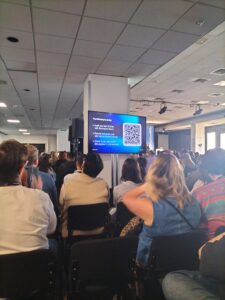
One final note from me: there seems to be an assumption among a good number of presenters that everyone in the audience has the ability to instantly scan a QR code while also paying attention to a fast-moving slide deck. Whether they think we’ve all upgraded to Google Glass or whether they’ve simply never tried to do it from a mid-auditorium seat, we’re not sure. But if you’re presenting at an event any time soon and want to routinely refer to your ‘super special, solve all of your problems’ guide (which I’m sure is brilliant), maybe give people a chance to actually get it down.
A More Serious Note
On a more serious note, Brighton SEO also made something increasingly apparent. Across both journeys, to and from Brighton, the journey was impacted by people attempting to take their own lives on the tracks. This has become an unfortunately familiar part of travel in the last few years but with numbers continuing to increase, it’s a reminder to reach out to those around us and keep checking in. For more information, please visit https://railsuicideprevention.co.uk/about/
BrightonSEO 2026 felt like a more grounded event than last year in some ways. The excitement around AI is still very much there, but it’s being channelled into more practical, actionable thinking. The industry is asking better questions: not just “what is AI doing to search?” but “how do we make our work genuinely useful in this new environment?”
The through-line for us remains the same as ever: produce content that’s actually good. Unique, human, specific, trustworthy, and well-structured. That’s what gets you in front of people, and increasingly, what gets you cited by the machines too.
We’re already taking this year’s learnings into our work. As always, if you’d like to chat through what any of this means for your own digital marketing strategy, feel free to get in touch via LinkedIn or our contact form; we’d love to hear from you.


